

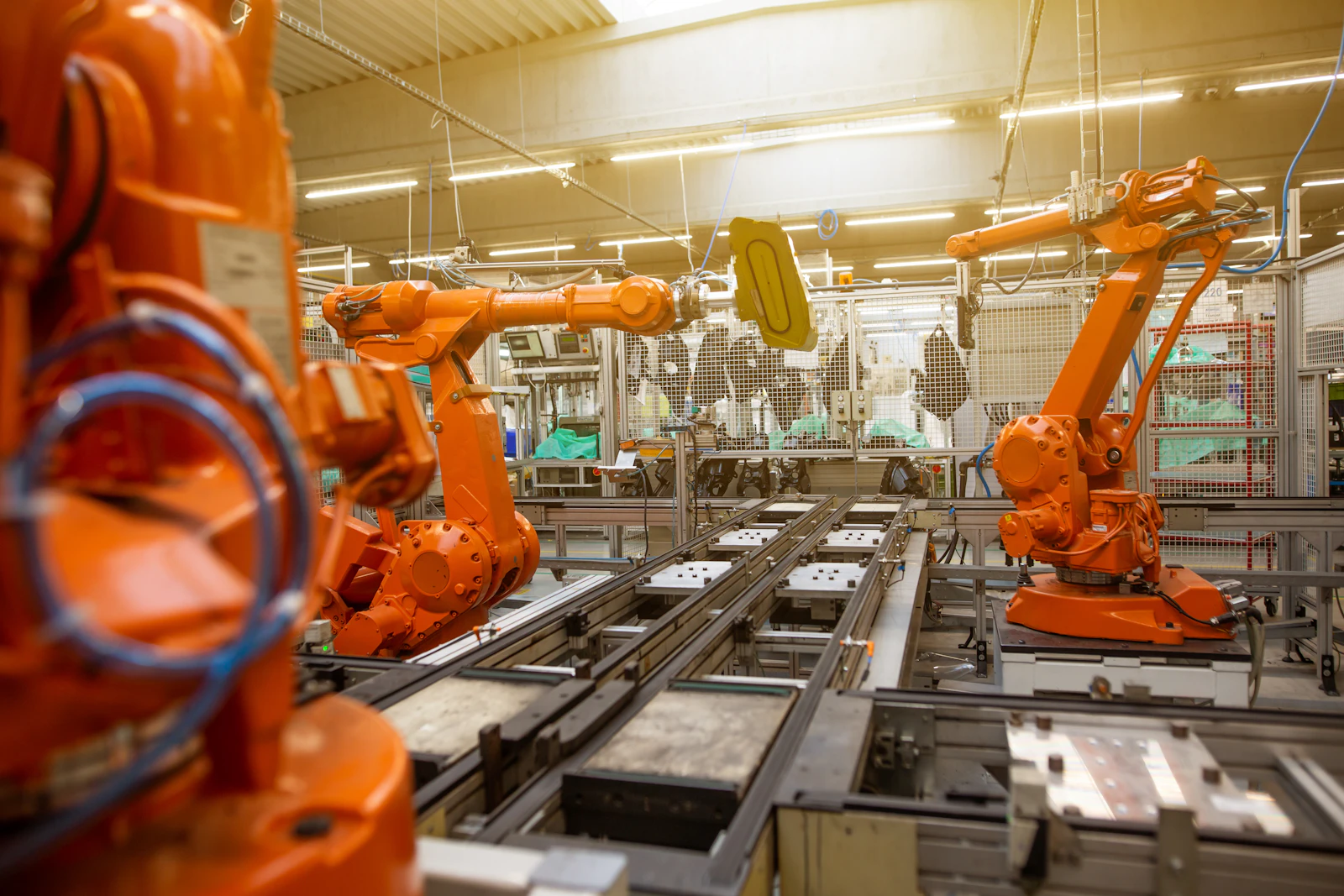
Disclosure: this article is based on Embodied AI’s announcement and coverage by robotics and technology outlets. We have not seen the robot in operation. Performance figures are the company’s own, and the photos show generic factory scenes, not the AIR robot.
On November 6, 2026, the Swiss startup Embodied AI unveiled the AIR humanoid at Humanoid Europe 2026 in Munich. It is a wheeled robot with a humanlike torso and two arms, built to work directly beside factory staff without a safety cage. Its arms are driven by tendons rather than motors in each joint, which makes them light and gives them a natural tendency to yield when they touch something.
The honest take: this is one of the more interesting factory robots of the year precisely because it does not try to be a general-purpose android. The AIR humanoid targets specific, repetitive jobs such as kitting, packaging and electronics assembly support, learns them from a human operator, and is designed around an international safety standard for shared workspaces. The caution is that its headline success rates come from the company, and how they were calculated has not been disclosed.
Table of Contents
- What the AIR Humanoid Is
- Why the AIR Humanoid Uses Tendon-Driven Arms
- An AIR Humanoid Without a Cage
- How the AIR Humanoid Learns a Job
- The AIR Humanoid Performance Claims
- The Company Behind the AIR Humanoid
- Where the AIR Humanoid Fits
- AIR Humanoid Questions a Buyer Should Ask
- Running an AIR Humanoid Pilot
- What the AIR Humanoid Says About Physical AI
- Who Should Look at What
- FAQ
- Verdict
- Sources and Further Reading

What the AIR Humanoid Is
The AIR humanoid is a two-armed mobile robot on a wheeled base. It has a humanlike upper body, which lets it reach the same shelves, benches and bins that people use, but it rolls rather than walks. That choice is deliberate. Legs are hard, expensive and rarely needed on a flat factory floor, while wheels are stable, efficient and proven.
Embodied AI built it for factory tasks that sit between full automation and manual labour: kitting parts into trays, packaging, and supporting surface-mount technology lines in electronics manufacturing. These are jobs where the products change often enough that a fixed robot cell is uneconomic, but the work is repetitive enough that people find it tedious.
The company says the robot went from first sketch to working machine in nine months, a fast development cycle for hardware of this complexity. Several outlets reported it is being tested with global manufacturers and that Embodied AI is beginning to plan scaled production.
On price, robot directories such as Humanoid Guide and Origin of Bots list an estimated figure of around $50,000, with Humanoid Guide marking the listing as not verified. Treat that as an indication of the intended price class rather than a quote.
Why the AIR Humanoid Uses Tendon-Driven Arms
Most industrial robot arms put a motor and gearbox in every joint. That makes them strong and precise, but also heavy. A heavy arm moving quickly carries a lot of energy, which is why traditional industrial robots work behind fences.
The AIR humanoid takes a different approach. Its motors sit in the torso, and cables, or tendons, run through the arms to move the joints, much as tendons in a human arm transmit force from muscles. Interesting Engineering described the result as lightweight, cable-driven arms that yield on contact.
The benefit is physical safety. A light arm with compliant joints carries far less energy, and because the drive is not rigid, it gives way when it meets resistance instead of pushing through. Embodied AI pairs this with compliant joints and high-frequency sensing so the robot notices contact quickly and stays gentle around people.
The design grew out of chief executive Francesco Stella’s PhD research at EPFL, the Swiss Federal Institute of Technology in Lausanne. Tendon-driven arms have long been studied in research labs; turning them into a reliable industrial product is the harder step.
An AIR Humanoid Without a Cage
The selling point is that the AIR humanoid can share a production line with workers. Origin of Bots reported that Embodied AI designed it around ISO/TS 15066, the international technical specification for collaborative robots working in shared spaces with people. The document sets limits on how much force and pressure a robot may apply if it touches a person.
That matters commercially as much as technically. Safety cages take floor space, cost money and force a factory layout around the robot rather than around the work. A robot that can stand at an ordinary workstation slots into existing lines with far less disruption.
It is worth being precise about what designing around a standard means. Compliance has to be assessed for each specific application, because the same robot may be safe for one task and not for another depending on speeds, tools and what it handles. Buyers should expect a risk assessment for their own line regardless of the robot’s design intent.
How the AIR Humanoid Learns a Job
This is the part that distinguishes it from most factory automation. Instead of being programmed for each task, the AIR humanoid learns from demonstration.
Every job starts with a human operator in control through remote teleoperation, so the robot is productive from its first shift. According to the company, every run is recorded, and Embodied AI’s AI stack learns from those demonstrations until AIR can do the task itself, typically within a month. The operator stays available to handle situations the robot has not seen before.
There is a network effect too. The company says what one robot learns can be used by the next. A task learned at one site does not need to be relearned from scratch at another.
Stella drew a sharp distinction between digital and physical AI. In his framing, errors from AI models are tolerable on screen because people review and correct output before acting on it, while a robot acting in the physical world gets no such review. The human-in-the-loop design is the company’s answer: keep a person in control until the robot has proven itself on that task.
It also explains the business model. Paying for an operator during the learning period costs money, but it means the robot earns its keep from day one rather than sitting idle during months of programming.
The AIR Humanoid Performance Claims
| Claim | Source | Caveat |
|---|---|---|
| 95% task success in paid pilots | Embodied AI, via Interesting Engineering | Calculation method not disclosed |
| 98% reliability on cable handling | Reported by AI Weekly | Single task type |
| Workload of up to three workers per shift | Embodied AI | Depends on the task |
| Autonomous on a new task within about a month | Embodied AI | Typical, not guaranteed |
Let’s Data Science noted that Interesting Engineering pointed out the company had not disclosed how its reported 95% success rate was calculated. That is the right question to ask. Success rate depends on what counts as a task, what counts as a failure, and whether human interventions are included. A robot that completes 95% of attempts but needs an operator to step in on many of them is a very different proposition from one that runs unattended.
The three-workers-per-shift figure needs similar care. Depending on the task, one robot may cover work that would occupy up to three people per shift. That likely reflects running across a full shift without breaks on a well-learned task. On a newly introduced or highly variable task, the number will be lower.
The Company Behind the AIR Humanoid
Embodied AI is small. Humanoid Guide describes it as a 25-person startup based in Lausanne with an office in Rome, spun out of EPFL. NVIDIA is listed as a partner, and the robot runs inference on board using the company’s own physical AI stack.
Robotics and Automation News reported that the company went from research to an industrial humanoid in nine months and signed contracts with major manufacturers globally, with a fraction of the spending other robotics companies have needed. The company’s AI stack had already been used in paid factory deployments with an earlier two-arm industrial cell, which suggests the learning approach was tested before it was put on a mobile robot.
That background is reassuring and limiting at once. A small, focused team can move quickly. Scaling production, service and support across multiple countries is a different challenge, and it is where many promising hardware startups struggle.
Where the AIR Humanoid Fits
The robotics market has split into two camps. One builds general-purpose humanoids with legs, aiming for robots that can eventually do anything a person can. The other builds task-focused machines for specific industrial jobs. The AIR humanoid sits clearly in the second camp, despite the humanoid label.
Embodied AI frames the robot as a helper rather than a replacement. Manufacturers across Europe report difficulty hiring for repetitive line work, and the company’s pitch is to take on the tedious tasks while staff move to supervision and more skilled work.
Good candidate tasks share a few traits: repetitive motions, moderate weights, products that change too often for a fixed robot cell, and a workstation that already exists for a person. Poor candidates involve heavy loads, very high speeds, or tasks that demand fine judgment about quality.
AIR Humanoid Questions a Buyer Should Ask
- How is success measured? Ask for the definition, the number of attempts and how interventions are counted.
- What does teleoperation cost? Who provides the operator during learning, for how long, and at what price?
- What is the safety case for my line? Request a task-specific risk assessment, not only the design standard.
- What happens with unfamiliar situations? Understand the fallback when the robot meets something new after the learning period.
- What are service and uptime commitments? A small company’s support coverage matters if the robot sits on a critical line.
- Who owns the learned skills? If demonstrations recorded at your site improve the shared model, clarify data rights and confidentiality.
Running an AIR Humanoid Pilot
A well-run pilot answers the questions above with your own data rather than the vendor’s. Keep it small and specific.
Choose one task on one workstation, ideally something your team finds tedious and that has a clear definition of done, such as filling a kit tray with a fixed set of parts. Measure the current baseline first: units per hour, error rate and the labour cost per shift.
Agree in writing how success is counted. Decide whether an operator stepping in counts as a failure, how long the learning period lasts, and what level of autonomy you expect by the end of it. Without that agreement, a pilot can look successful on paper and still disappoint on the floor.
Involve the people who work at that station. They know the awkward parts, the failure modes and the workarounds, and their acceptance will decide whether a cage-free robot is welcomed or resented. Ask them to log anything the robot does that surprises them.
At the end, compare like with like: cost per unit including the robot, the operator time and any support, against the baseline. If the AIR humanoid wins on one task, the next question is how quickly the same learning approach transfers to a second task on another line.
What the AIR Humanoid Says About Physical AI
The AIR humanoid is a useful example of how AI is moving from screens into the physical world, and of how different the problems are once it does.
Software AI can be wrong cheaply. A chatbot’s mistake costs a few seconds and a correction. A robot’s mistake can damage a product, a machine or a person. That raises the bar for reliability far above what digital AI needs, and it is why learning approaches that keep a human in control during training are becoming common across robotics.
It also changes the economics. Large language models scale by copying software to more servers. Robots scale by building, shipping and maintaining machines. The idea that what one robot learns, the next can use, is the robotics version of software scaling, and it is central to whether companies like Embodied AI can grow quickly.
The data question is the one to watch. Every demonstration recorded on a customer’s line is training data. Who owns it, whether it can improve robots at competitors’ sites, and how it is protected are questions that factory buyers will increasingly put into contracts.
Finally, it shows the value of narrow focus. General-purpose humanoids attract headlines, but robots that do a handful of jobs reliably are the ones reaching paid deployments now. The AIR humanoid is a bet that the path to general robotics runs through specific, profitable tasks first.
Who Should Look at What
| If you are | Start with | Why | Link |
|---|---|---|---|
| A manufacturer with repetitive kitting or packing | An AIR humanoid pilot | Cage-free, learns your task by demonstration | Read the launch |
| Running heavy or high-speed lines | Conventional industrial robots | Designed for those loads and speeds | Compare approaches |
| Evaluating several humanoid vendors | Robot directories and spec sheets | Side-by-side listings | See the listing |
| Interested in the AI behind it | Coverage of physical AI stacks | Context on learning from demonstration | Read more |
Related on this site: for more context, see AI Desktop Agents, Vera Rubin Is Shipping and AI Hiring in 2026.
Frequently Asked Questions About the AIR Humanoid
What is the AIR humanoid?
A wheeled, two-armed factory robot from Swiss startup Embodied AI, designed to work beside people without a safety cage. It was unveiled at Humanoid Europe 2026 in Munich on November 6.
How does it learn tasks?
A human operator controls it remotely at first. Every run is recorded, and the company’s AI learns from those demonstrations until the robot can do the task itself, typically within about a month.
Is it safe around people?
It uses lightweight tendon-driven arms that yield on contact, compliant joints and fast sensing, and the company says it was designed around ISO/TS 15066. Each application still needs its own risk assessment.
How much does it cost?
Embodied AI has not published a price. Robot directories list an estimate of around $50,000, marked as unverified, and sales are by quote.
How reliable is it?
The company reports 95% task success in paid pilots and 98% on cable handling, but has not disclosed how those figures were calculated.
Who makes it?
Embodied AI, a roughly 25-person EPFL spin-out based in Lausanne with an office in Rome, led by co-founder and chief executive Francesco Stella.
Verdict
If you run repetitive kitting, packing or electronics-support work and struggle to hire for it, the AIR humanoid is worth a pilot conversation. Its cage-free design and learn-by-demonstration approach address the two biggest barriers to robots on mixed production lines: floor space and programming time.
The honest caveat is that it is brand new, its performance figures are self-reported with undisclosed methods, the price is unconfirmed, and the company is small. Hardware startups often find scaling harder than building the first robots.
Next step: pick one well-defined task on an existing workstation, ask Embodied AI for a pilot with clearly defined success metrics, including how interventions are counted, and compare the result with your current cost per shift.
Sources and Further Reading
- Robotics 24/7: AIR launch, for the announcement and production plans.
- Interesting Engineering: wheeled humanoid, for the arm design and pilot claims.
- Robotics and Automation News, for the learning process and company background.
- Origin of Bots: learns on the shift, for the safety standard.
- Let’s Data Science: without safety cages, for the caveat on success-rate methodology.
On this site: see how software agents work in AI browser agents, understand agent risks in prompt injection and agent security, compare the models behind physical AI in AI models compared, and run models on-device with best local LLMs.