


Table of Contents
- The Question Behind the Question
- Airflow: The Incumbent
- Dagster: The Asset-Based Challenger
- Prefect: The Python-Native Option
- Head to Head
- Developer Experience, Which Decides Adoption
- Deployment and Cost
- What Changes as You Grow
- Observability Matters More Than the Engine
- How to Pick in Ten Minutes
- Should You Migrate?
- The Cost Nobody Models
- If You Are Starting From Nothing
- Six Mistakes That Are Not the Tool’s Fault
- Using More Than One
- Frequently Asked Questions
- Final Thoughts
Every Airflow vs Dagster vs Prefect comparison eventually says the same thing: they are all good, pick the one that fits your team. That is true and completely useless when you have to actually decide.
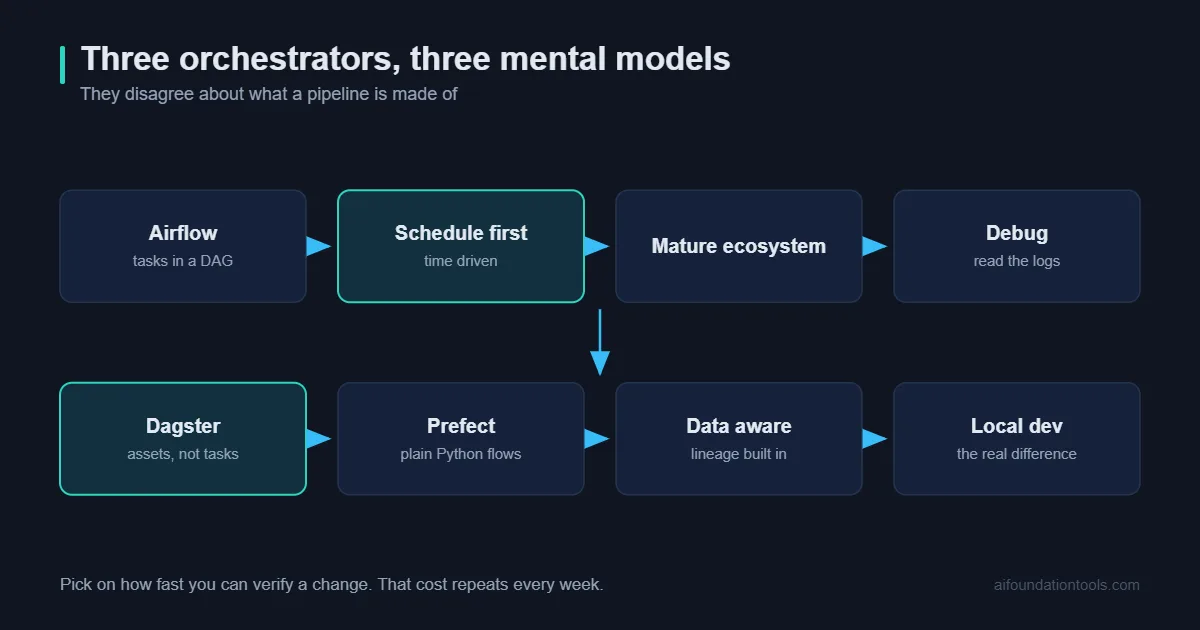
So here is a more useful framing. These three tools disagree about something fundamental – what an orchestrator is supposed to keep track of – and that disagreement predicts almost everything else about them.

Airflow vs Dagster: The Question Behind the Question
The short version of Airflow vs Dagster: Airflow tracks tasks. Did this job run? Did it succeed? What runs next?
Dagster tracks assets. Does this table exist? Is it fresh? What produced it, and what depends on it?
Prefect tracks flows and deliberately holds few opinions beyond that. It gives you a scheduler, observability and retries, then stays out of your way.
That difference is not cosmetic. If your orchestrator only knows that a job succeeded, it cannot tell you whether the table that job was supposed to produce is actually correct or current. Every data orchestration failure that ends with “the pipeline ran fine but the numbers were wrong” lives in that gap.
Whether closing that gap is worth changing tools is the real question, and the honest answer depends on how often you are asked why a number looks wrong.
Airflow: The Incumbent
Apache Airflow has been the default for long enough that “we use Airflow” is closer to a description of the industry than a choice.
What it genuinely does well. The ecosystem is unmatched – a provider package exists for essentially every system you might touch. Complex scheduling and backfills are well-handled. And practically speaking, hiring is easier: people arrive knowing it.
Where it hurts. Local development is still awkward compared to the alternatives. Passing data between tasks was retrofitted rather than designed in. And the task-level view means you get no lineage for free – you know what ran, not what it produced.
Pick it if: you have a large team, complex cross-system dependencies, or an existing deployment that works. “It is already running and nobody complains” is a legitimate reason to stay.
Dagster: The Asset-Based Challenger
Dagster is the fastest-growing option, and the growth is not marketing – it comes from the asset model solving a real problem.
You declare what should exist rather than what should run. This table. This model. This report. Dagster works out the dependency graph, what needs rebuilding, and what is stale.
What you get for that. Lineage without instrumenting anything. Freshness policies you can declare rather than compute. Partial rebuilds when only part of the graph changed. And a development experience that is genuinely better – types, testable components, a local UI that works.
Where it hurts. The mental shift is real if you have years of task-based habits. The ecosystem, while growing quickly, is smaller. And for genuinely simple pipelines the asset abstraction is overhead you do not need.
Pick it if: you spend meaningful time answering “why is this number wrong”, or your data orchestration is closely tied to dbt models and warehouse tables.
Prefect: The Python-Native Option
Prefect takes the opposite approach to Dagster. Rather than adding structure, it removes it.
Your pipeline is Python functions with decorators. Dynamic workflows – where the shape of the graph depends on runtime data – are straightforward rather than a fight. Local development is just running Python.
What you get. The lowest friction of the three for a Python team. Genuinely dynamic DAGs. And a hybrid execution model where the control plane can be managed while your code runs entirely on your infrastructure, which resolves a lot of data-residency objections.
Where it hurts. Fewer opinions means less consistency across a team. No asset-level lineage. And the flexibility that makes it pleasant for one engineer can produce sprawl across ten.
Pick it if: your workloads are Python-heavy, dynamic, or ML-adjacent, and your team values flexibility over structure.
Airflow vs Dagster vs Prefect: Head to Head
| Airflow | Dagster | Prefect | |
|---|---|---|---|
| Core abstraction | Tasks | Assets | Flows |
| Built-in lineage | No | Yes | Limited |
| Local development | Awkward | Good | Excellent |
| Dynamic workflows | Limited | Supported | Native |
| Ecosystem size | Largest | Growing | Moderate |
| Hiring pool | Largest | Smaller | Smaller |
| Testing story | Weak | Strong | Good |
| dbt integration | Via operator | First-class | Via block |
| Learning curve | Moderate | Steeper concepts | Gentlest |
Developer Experience, Which Decides Adoption
This is where the decision is actually made, whatever the evaluation criteria say.
The question that predicts everything: how long does it take to change one line and see whether it worked?
On Prefect, seconds – you run the Python. On Dagster, seconds to a minute with a local UI that shows you the graph. On Airflow, historically several minutes and a container restart, though this has improved.
That loop compounds. A team iterating in seconds writes more tests and tries more things than one waiting minutes per change. Over a year the difference in pipeline quality is substantial, and it has nothing to do with any feature comparison.
Second question: can you test a pipeline without running it against production? Dagster was designed for this. Prefect makes it straightforward because it is just Python. Airflow requires deliberate effort.
Deployment and Cost
All three offer self-hosted open source and a managed option, and the pricing models differ in ways worth understanding before you commit.
Self-hosting means running a scheduler, a database, workers and a web server. Airflow is the heaviest; Prefect the lightest. Budget real engineering time regardless of which – this is infrastructure, and unmaintained infrastructure fails at inconvenient times.
Managed options remove that burden and charge for it. Watch the pricing unit: some charge by task or run, which punishes fine-grained pipelines – exactly the pipelines you should be writing.
The hybrid model Prefect popularised is worth knowing about: the control plane is hosted, execution stays on your infrastructure. You get the operational relief without your data leaving your network.
The number people forget is not licence cost. It is the engineer-hours spent maintaining a self-hosted deployment, which for the heavier options is not small.
What Changes as You Grow
The right answer at ten pipelines is frequently the wrong answer at two hundred, and the failure modes are predictable.
Under twenty pipelines, almost any choice works. Prefect will feel fastest, Airflow heaviest. The main risk at this size is building more infrastructure than the problem justifies.
Between twenty and a hundred, the cracks appear. You start needing to know which pipeline produced which table, who owns what, and why something is stale. This is the range where asset-based data orchestration starts paying for itself, because the questions being asked change from “did it run” to “is it correct”.
Past a hundred, the constraints become organisational rather than technical. Multiple teams, conflicting schedules, shared upstream dependencies, and the need for someone to be accountable for each pipeline. At this scale the ecosystem and hiring advantages of Airflow start to weigh heavily again, which is why large organisations often stay on it despite the developer experience.
The trap is choosing for the scale you aspire to. A team of three building for two hundred pipelines will spend a year maintaining infrastructure for a problem they do not have.
Observability Matters More Than the Engine
Whichever you choose, four things determine whether people trust the output. None of them are default behaviour.
Failure alerts that reach a person. Not a dashboard nobody opens. A message, to a named owner, with enough context to act.
Freshness monitoring. A pipeline that silently stopped is the most expensive failure mode in data orchestration, because nobody knows the numbers are stale. Dagster declares this natively; on the others you build it.
Run history you can search. When something broke last Tuesday, you need to see what ran, what it consumed and what changed. All three provide this; the quality varies.
A dependency graph a human can read. Not for the tool – for the person who joins next year and needs to understand what breaks if they change one model.
Teams that get these four right are trusted regardless of engine. Teams that skip them end up with beautifully architected pipelines that nobody believes.
Airflow vs Dagster vs Prefect: How to Pick in Ten Minutes
- Already running Airflow and it works? Stay. Migration cost is real and “it works” is a strong position.
- Do you regularly investigate why a number is wrong? Dagster. Asset lineage is aimed precisely at that.
- Is your pipeline mostly dbt plus warehouse tables? Dagster, whose model maps almost exactly onto that shape.
- Python-heavy, dynamic, or ML workloads? Prefect.
- Large team, many integrations, need easy hiring? Airflow.
- Starting fresh with a small team? Dagster or Prefect. Both are pleasanter than Airflow in 2026, and starting fresh is the cheapest time to choose.
If none of those decide it, choose Dagster for analytics data orchestration and Prefect for engineering workloads. Both are safe defaults.
Should You Migrate?
Usually not, and the reasons people give for migrating are frequently not the real problem.
Bad reasons: the new tool is fashionable, a conference talk was persuasive, someone on the team wants to learn it. None of these survive contact with a three-month migration.
Legitimate reasons: you spend hours weekly on lineage questions your current tool cannot answer; local development friction is measurably slowing the team; your managed bill is growing faster than your pipeline count.
If you do migrate, do it incrementally. Run both, move one pipeline, let it prove itself for a month. A big-bang orchestrator migration is one of the more reliable ways to spend a quarter badly.
The Cost Nobody Models
Every comparison of these tools eventually reaches pricing, and every one of them measures the wrong thing.
The licence is rarely the expensive part. Three other costs matter more.
Compute triggered, not orchestration itself. Your orchestrator costs very little to run. The warehouse queries it triggers hourly cost a great deal. A schedule set to hourly out of habit, on data that updates daily, quietly multiplies your largest bill by twenty-four.
The engineer maintaining it. Self-hosting looks free until you price the time. Upgrades, scaling, database maintenance, the occasional weekend incident. For the heavier options this is a meaningful fraction of a person indefinitely.
Time lost to bad feedback loops. If changing one line takes five minutes to verify, and your team makes fifty changes a week, that is four hours weekly spent waiting. Over a year it exceeds any licence difference between these tools.
That last one is why developer experience keeps appearing in this comparison. It is not a preference – it is the largest recurring cost in data orchestration, and it is the one that never appears on a pricing page.
If You Are Starting From Nothing
A short sequence that avoids the common traps.
Week one: do not install an orchestrator. Write your pipelines as plain scripts, scheduled simply. You will learn what your dependencies actually are, which is the information you need to choose well.
Week two: identify the pain. Is it that jobs fail silently? That one job needs to wait for another? That nobody knows what produced a table? Each points at a different tool.
Week three: install one, migrate two pipelines. Not everything. Two, so you learn the deployment story without committing.
Week four: add alerting before adding pipelines. An orchestrator without failure notifications is a scheduler with a nicer interface.
Teams that follow roughly this order end up with data orchestration they understand. Teams that install Airflow on day one because it is the standard usually spend a month on infrastructure before writing a pipeline.
Six Mistakes That Are Not the Tool’s Fault
1. One enormous DAG. A single graph doing everything cannot be retried partially or reasoned about. Split by domain.
2. Business logic inside the orchestrator. Transformation belongs in dbt or your application. Orchestrators schedule and monitor. Transformation belongs in dbt or your application, where it can be tested and reviewed.
3. No alerting. All three will tell you when something failed. None will do it unless you configure it.
4. Scheduling everything hourly by default. Cost scales with runs. Match frequency to how often the source data actually changes.
5. No retries or bad ones. Transient failures are normal. Retries with backoff eliminate most 3am pages; infinite retries on a genuine error just hide it.
6. Treating it as set-and-forget. Data orchestration is production infrastructure with a named owner, or it decays.
Using More Than One
Worth mentioning because it is more common than the Airflow vs Dagster framing suggests: plenty of organisations run two orchestrators deliberately.
The usual split is analytics on one and machine learning on another. Analytics pipelines are scheduled, warehouse-centric and benefit from asset awareness. ML workloads are dynamic, compute-heavy and benefit from Python flexibility. Forcing both into one tool means one of them is being served badly.
This is not architectural failure. It is the same logic that leads to composable data stacks generally – specialised tools doing one job properly rather than one platform doing several adequately.
The cost is real though: two systems to maintain, two sets of conventions, and a boundary that someone has to own. Only worth it when the two workloads are genuinely different in shape, not merely owned by different teams.
If you do split, keep one rule: a single source of truth for lineage across both. The whole point of data orchestration is knowing what produced what, and that breaks the moment your graph has a hole in the middle of it.
Frequently Asked Questions
Airflow vs Dagster: which is best for dbt?
Dagster, by a clear margin. It models dbt models as assets natively, so lineage extends through your transformations rather than stopping at the job boundary.
Is Airflow dying?
No. It remains the most widely deployed orchestrator with the largest ecosystem. It is no longer the automatic choice for new projects, which is different.
Can I use these for machine learning pipelines?
All three, though Prefect suits dynamic ML workflows best. Dedicated ML orchestrators exist but are frequently more than a small team needs.
Do I need an orchestrator at all?
Not if you have a handful of independent jobs. Our roundup of data pipeline tools covers the wider stack, and if you are orchestrating AI workloads specifically, our guide to n8n AI agents covers a lighter alternative. You need one when jobs depend on each other and failures need handling – see our overview of data pipeline tools for where orchestration fits.
What about lighter alternatives?
Options like Mage and Kestra are genuinely simpler and worth considering for small teams. The trade is ecosystem depth and long-term certainty.
How long does a migration take?
Plan a quarter for a moderately complex deployment, done incrementally. Anyone quoting weeks has not counted the edge cases.
Final Thoughts
The Airflow vs Dagster vs Prefect question is converging on capabilities and diverging on philosophy, which is the opposite of how these comparisons usually go. Airflow is adding asset awareness. Dagster is broadening its ecosystem. Prefect is adding structure. In two years the feature tables will look similar.
What will not converge is the mental model. Tasks, assets or flows is a genuine choice about how your team thinks about data, and it is worth deciding deliberately rather than defaulting.
On Airflow vs Dagster for a fresh start: Dagster for analytics and Prefect for engineering are the strongest defaults. If you are already on Airflow and nobody is complaining, the best data orchestration decision available to you is to leave it alone and go fix something that is actually broken.
Sources and Further Reading
- Apache Airflow documentation, the incumbent orchestrator’s official docs
- Dagster documentation, the asset-centric alternative
- Prefect documentation, the Python-native lightweight option
Related on this site: data pipeline tools and MLOps tools compared.