


Table of Contents
- Five Layers, Not One Platform
- Experiment Tracking
- Data and Model Versioning
- Pipeline Orchestration
- Model Serving
- Monitoring and Drift Detection
- How the Layers Actually Connect
- The All-in-One Platforms
- The Stack at a Glance
- Three Stacks That Work
- A Realistic Adoption Sequence
- Where the Money Goes
- How to Choose Without Overbuilding
- Five Signs You Have Outgrown Your Stack
- Frequently Asked Questions
- Final Thoughts
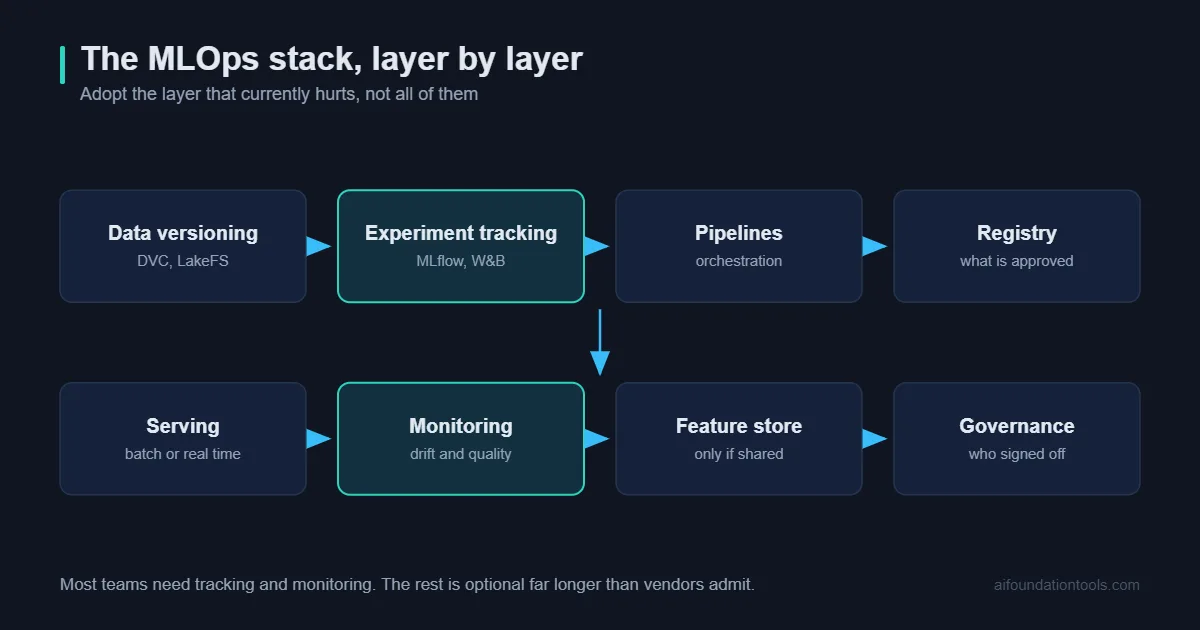
The single most useful fact about MLOps tools is that no product does all of it well, and every vendor claims otherwise.
The category splits into five distinct layers with different tools winning each. Understanding that split turns an overwhelming market into five manageable decisions, most of which have an obvious default.

MLOps Tools Split Into Five Layers
Experiment tracking — recording what you tried and what happened.
Versioning — knowing which data and which model produced a result.
Orchestration, running training as a repeatable pipeline.
Serving, exposing predictions reliably.
Monitoring, noticing when it stops working.
Teams typically adopt MLOps tools in that order, and each layer only becomes urgent once the previous one exists. Buying a platform that covers all five before you need any of them is the most common way to waste a quarter. The concepts underneath are covered in our guide to what MLOps actually involves.
Experiment Tracking
MLflow
The de facto standard, and the default recommendation for most teams. Open source, self-hostable, tracks parameters, metrics and artefacts, and includes a model registry, which means it covers two layers rather than one.
The trade: the interface is functional rather than pleasant, and collaboration features are thin compared to commercial options.
Weights & Biases
The commercial alternative, and noticeably better at the things MLflow does adequately, visualisation, comparison across runs, sharing results with people who did not run them.
The trade: a hosted service with per-seat pricing. For research teams running many experiments it earns its cost quickly; for a team shipping one model a quarter it does not.
Neptune
Similar positioning to W&B with a focus on very high experiment volumes and long-running training. Worth evaluating if you are logging at a scale where other tools become sluggish.
Reasonable default: MLflow unless someone is actively frustrated by it.
Data and Model Versioning
DVC
Git for data. Large files live in object storage while lightweight pointers live in your repository, so a commit captures code and data together.
Conceptually elegant and genuinely useful for reproducibility. It does require the team to adopt a workflow, which is where adoption usually stalls.
Model registries
Frequently this is just MLflow’s registry, which is one reason MLflow spread so widely. A registry answers three questions: what is in production, what produced it, and how do I roll back. Any tool that answers those adequately is sufficient.
Reasonable default: MLflow’s registry, plus DVC only if data reproducibility is a genuine requirement rather than an aspiration.
Pipeline Orchestration
Kubeflow
The Kubernetes-native option. Powerful, full, and a substantial operational commitment. Right if you already run Kubernetes seriously and have people who operate it.
The trade: the complexity is real. Plenty of teams adopted Kubeflow and spent more time on the platform than the models.
General-purpose orchestrators
Airflow, Dagster and Prefect all run ML pipelines perfectly well, and using the same orchestrator as your data team is an underrated advantage, shared conventions, shared on-call, one system to learn. Our orchestrator comparison covers the differences.
Metaflow
Built for data scientists rather than platform engineers. Write Python, get versioning and scaling handled. Pleasant to use and less flexible than the alternatives.
Reasonable default: whatever your data team already runs, unless you are Kubernetes-native.
Model Serving
BentoML
Packages a model with its dependencies into a deployable unit, handles batching and scaling, and stays out of your way otherwise. The most straightforward path from trained model to working endpoint.
KServe and Seldon
Kubernetes-native serving with the production features that matter at scale, canary rollouts, shadow deployment, autoscaling to zero. More capable and considerably more setup.
Just a web framework
Worth saying plainly: for one model at modest traffic, wrapping it in FastAPI behind a container is completely legitimate. A meaningful share of production ML runs this way and always will.
Reasonable default: BentoML for most teams, KServe if you are already on Kubernetes at scale, a plain web framework if you have one model.
Monitoring and Drift Detection
The layer with the least adoption and the most consequence, because this is where silent failure gets caught.
Evidently
Open source, generates drift and quality reports, integrates into pipelines. The sensible starting point. You can add meaningful monitoring in an afternoon.
Arize, Fiddler and WhyLabs
Commercial platforms with drift detection, root-cause analysis and increasingly LLM-specific signals. Worth the cost when model failure is expensive and you need to diagnose quickly rather than eventually.
Your existing observability stack
Latency, error rates and throughput belong wherever your other services report. Only the statistical monitoring needs specialised MLOps tools.
Reasonable default: Evidently, escalating to a commercial platform when the cost of a wrong prediction justifies it.
How the Layers Actually Connect
The diagrams make this look tidier than it is. In practice the joins between layers are where most of the engineering time goes.
Tracking to registry is usually clean, because the same tool typically does both. This is the one join that just works, and it is a large part of why MLflow spread the way it did.
Registry to serving is the join people underestimate. Your serving layer needs to pull a specific model version, load it with the right dependencies, and expose which version answered each request. If you cannot trace a prediction back to a model version, rollback becomes guesswork.
Serving to monitoring requires logging inputs and outputs somewhere durable, with enough metadata to join against ground truth when it eventually arrives. This is plumbing, not intelligence, and skipping it is why so many teams have monitoring dashboards that cannot answer whether the model is right.
Monitoring back to training closes the loop. When drift is detected, the retraining pipeline needs the recent data and a way to compare the candidate against the incumbent before promotion.
Every all-in-one platform sells itself on handling these joins for you, and that is a real benefit rather than marketing. The counter-argument is that the joins are also where lock-in lives, the more of your workflow lives in a vendor’s format, the more expensive leaving becomes. Best-of-breed MLOps tools mean more integration work and more portability, and which trade suits you depends less on your stack than on how long you expect to be running it.
The All-in-One Platforms
SageMaker, Vertex AI and Azure ML each cover all five layers within their cloud.
The case for: integration is genuine, provisioning is a click, and it is one vendor relationship. For teams already committed to a cloud with no platform engineering capacity, this is frequently the right answer.
The case against: each layer is adequate rather than best, and the lock-in is real, pipelines written against a proprietary SDK do not port. You are trading capability and portability for convenience.
The pattern worth noticing: teams start on the managed platform for speed, then peel off individual layers as they outgrow them. That is a perfectly reasonable path, provided you keep your training code portable.
The MLOps Stack at a Glance
| Layer | Default pick | Alternative | When to upgrade |
|---|---|---|---|
| Experiment tracking | MLflow | Weights & Biases | Many experiments, team collaboration |
| Versioning | MLflow registry | DVC | Data reproducibility is a requirement |
| Orchestration | Your data team’s tool | Kubeflow, Metaflow | Kubernetes-native at scale |
| Serving | BentoML | KServe, FastAPI | Canary and shadow deployment needed |
| Monitoring | Evidently | Arize, Fiddler | Wrong predictions are expensive |
Three MLOps Stacks That Work
The lean stack. MLflow for tracking and registry, your existing orchestrator, FastAPI or BentoML for serving, Evidently for monitoring. Entirely open source, genuinely capable, and maintainable by one person.
The Kubernetes stack. Kubeflow for pipelines, KServe for serving, MLflow or W&B for tracking, a commercial monitoring platform. Powerful, and it assumes a platform team exists.
The managed stack. Your cloud provider’s ML platform end to end, with training code kept deliberately portable. Fastest to value, most lock-in.
Most teams should start lean. The lean stack handles considerably more than people expect, and outgrowing it is a good problem that arrives later than feared.
A Realistic Adoption Sequence
Six months, in the order that actually works rather than the order the diagrams suggest.
Month one: tracking only. Install MLflow, log every run. Change nothing else. By the end of the month you can answer what produced a given result, which is the question that blocks everything downstream.
Month two: get training out of notebooks. A parameterised script someone else can run. Not a pipeline yet – just reproducible.
Month three: register models. One place recording what is deployed and what produced it. This is where MLOps tools start paying back visibly, because rollback becomes possible.
Month four: log production inputs. Not sophisticated drift detection – just capture what the model receives and compare distributions weekly by hand. You will learn more from this than from any dashboard.
Month five: automate the pipeline. Now that training is reproducible and models are registered, scheduling it is a small step rather than a project.
Month six: proper monitoring. Evidently or a commercial platform, with alerts to a named person.
Notice that automation comes fifth. Teams who invert this – automating before they can reproduce or evaluate – build pipelines that reliably produce models nobody trusts.
Where the Money Goes
Three costs, and the ranking surprises people used to buying software.
Licences are the smallest. A fully open-source stack covering all five layers is genuinely viable and genuinely good. Commercial MLOps tools buy interface quality, support and time – not capability you cannot otherwise get.
Compute is lumpy but predictable. Training spikes, serving is steady. The common waste is over-provisioned serving infrastructure for a model handling a trickle of requests.
People dominate. Someone maintains the pipelines, investigates degradation and keeps evaluation sets current. This does not shrink as tooling improves; it shifts from setup to operation.
The calculation worth doing first: what does one wrong prediction cost, times how many you would make before noticing? That number justifies your monitoring investment more honestly than any feature comparison.
How to Choose MLOps Tools Without Overbuilding
- Do you have a model in production? If not, you need experiment tracking and nothing else. Install MLflow, move on.
- Can you reproduce your production model? If not, fix versioning before anything else.
- Is training a manual process? Then orchestration, using whatever your data team already runs.
- Would you know if the model degraded? If the honest answer is no, monitoring is your highest-value next step regardless of what else is missing.
- Are you fighting your serving setup? Only then is dedicated serving infrastructure worth the complexity.
The failure mode with MLOps tools is not choosing badly. It is adopting five of them in month one, spending a quarter integrating them, and shipping nothing.
Five Signs You Have Outgrown Your Stack
Rather than upgrading on a schedule, watch for these. Each maps to a specific layer.
You cannot answer what is in production. Someone asks which model version is serving and it takes more than a minute. You need a registry, and you needed it a while ago.
Two people get different results from the same code. A versioning problem. Usually the data differs, occasionally the environment.
Retraining is a person’s afternoon. If a human runs the pipeline by hand each time, orchestration will pay for itself within a quarter.
Deployments are scary. If shipping a new model version feels risky, you lack rollback and staged rollout. That is a serving-layer gap and it makes teams ship less often, which compounds.
A customer told you the model was wrong. The clearest signal of all. Monitoring should have told you first, and this is the failure that justifies more investment than any other.
The useful discipline is to treat each of these as a trigger rather than a preference. Adopting MLOps tools in response to a named problem produces stacks people use; adopting them in response to a roadmap produces stacks people work around.
Frequently Asked Questions
Do I need all five layers?
No. Most teams genuinely need experiment tracking and a registry. The rest becomes necessary as models multiply and stakes rise.
Is MLflow enough on its own?
For a lot of teams, close to it. Tracking and registry cover the two layers that matter earliest, which is why it is so widely adopted.
Open source or commercial?
Open source covers every layer competently. Commercial tools buy convenience, support and better interfaces. Neither choice is wrong; pricing your own time honestly decides it.
What about LLM applications?
Different emphasis, prompt versioning and evaluation rather than training pipelines. Several MLOps tools now cover this, and dedicated LLM observability platforms exist.
Does a small team need any of this?
Experiment tracking, yes, immediately. It costs an afternoon and saves you the day you are asked what produced the model in production.
How do I avoid lock-in?
Keep training code framework-agnostic and store artefacts in your own object storage. Then the platform around them is replaceable.
Final Thoughts
The MLOps tools market looks crowded because it is five markets wearing one label. Split it into layers and most of the decisions have an obvious default. MLflow, your existing orchestrator, BentoML, Evidently.
The teams that struggle are rarely the ones who picked the wrong tool. They are the ones who adopted a platform before they had a problem it solved, then spent months maintaining infrastructure for models they had not shipped.
Install experiment tracking today. Add the next layer when something specific hurts. That sequence produces working systems considerably faster than choosing a platform first.