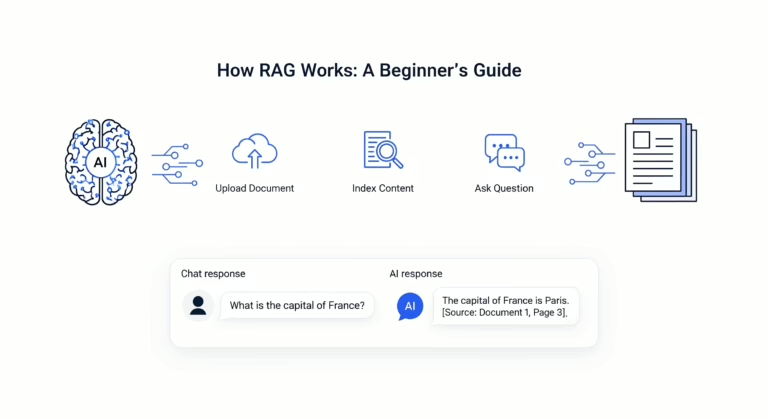
In the rapidly evolving world of artificial intelligence, Retrieval-Augmented Generation (RAG) has emerged as a cornerstone technology for building intelligent, knowledge-grounded applications. It promises to solve one of the most significant limitations of large language models (LLMs)—their tendency to hallucinate or rely on outdated, static training data. However, traditional RAG implementations often stumble when faced with the complex, messy reality of enterprise documents. They treat PDFs, Word files, and presentations as simple blocks of text, losing critical structure, meaning, and context.
This is where RAGFlow enters the stage, not just as another RAG tool, but as a transformative open-source engine designed for deep, intelligent document comprehension. It is poised to redefine how AI interacts with human knowledge.
Table of Contents
What is RAGFlow? Beyond Basic Retrieval
RAGFlow is an open-source RAG engine developed by Infinigence.AI. At its core, it enhances the standard RAG pipeline by incorporating deep document understanding. Unlike naive approaches that might simply chunk a document into arbitrary text segments, RAGFlow parses documents with a human-like appreciation for their inherent structure.
Think of it this way: a standard RAG system might look at a complex annual report and see a wall of text. RAGFlow, however, recognizes the title, the executive summary, the financial data in tables, the captions under charts, and the footnotes. It understands that a header in a legal contract carries more weight than a sentence in a paragraph. This foundational difference in approach leads to a dramatically more accurate and contextually relevant retrieval process, which in turn supercharges the quality of the AI’s final generated response.
The Critical Gap in Traditional RAG That RAGFlow Fills
To fully appreciate RAGFlow’s value, we must first understand the shortcomings of conventional RAG systems.
The “Blind” Chunking Problem
Most basic RAG systems use a one-size-fits-all approach to chunking documents. They break text into segments of a fixed token size (e.g., 512 tokens), often without regard for semantic boundaries. This can be disastrous.
- Severed Meaning: A critical sentence can be split between two chunks, rendering both chunks meaningless.
- Lost Structure: A table is shredded into incoherent text fragments, losing all the relational data within.
- Ignored Hierarchy: Titles, section headers, and bullet points are treated with the same importance as body text, confusing the retrieval model.
The “Static Retrieval” Problem
Many systems perform a simple semantic similarity search. They convert a user’s query and document chunks into vectors and retrieve the most similar ones. However, this often fails with complex queries.
- Keyword Mismatch: A user asking “What were our operational highlights in Europe?” might not retrieve a chunk titled “Q3 Regional Performance” if the vector space doesn’t align perfectly, even though the content is relevant.
- Lack of Reasoning: Basic retrieval cannot handle multi-step reasoning or filter based on multiple metadata criteria simultaneously.
RAGFlow is engineered from the ground up to address these very issues, turning document understanding from an afterthought into its primary strength.
Core Features That Make RAGFlow a Game-Changer
RAGFlow’s power lies in its sophisticated feature set, which collectively enables a level of document intelligence previously difficult to achieve without custom, expensive development.
1. Deep Document Understanding with Multi-Modal Parsing
This is RAGFlow’s flagship capability. It doesn’t just read text; it interprets documents.
- Text and Layout Awareness: It identifies and tags titles, paragraphs, headers, and captions, preserving the logical flow of the document.
- Table and Chart Comprehension: It extracts data from tables and figures with remarkable accuracy, converting them into a structured, queryable format. This is a monumental leap for analyzing financial reports or scientific papers.
- Multi-Format Support: It seamlessly parses a wide range of formats, including PDF, PPT, Word, Excel, and TXT files.
2. Intelligent, Dynamic Text Chunking
RAGFlow moves far beyond fixed-size chunking. It offers:
- Semantic-Aware Chunking: It splits text at natural semantic boundaries, such as the end of a section or a sub-topic, ensuring each chunk is a coherent unit of meaning.
- User-Defined Chunking Rules: You can define rules based on your specific document types. For instance, you can instruct it to treat each slide in a presentation as a single chunk or to keep specific sections of a legal document intact.
3. A “Dual-Route” Retrieval Mechanism
This is where RAGFlow’s retrieval truly shines. It doesn’t rely on a single method but employs a hybrid, two-pronged approach:
- Vector-Based Semantic Search: Like traditional RAG, it uses vector embeddings to find chunks that are semantically similar to the user’s query.
- Keyword-Based Full-Text Search: It simultaneously performs a fast, traditional keyword search to catch relevant information that might have a different semantic expression.
The results from both routes are then intelligently re-ranked and synthesized, ensuring that the most relevant information is retrieved, whether it matches by meaning, by keyword, or both.
4. A Visual and Traceable Grounding System
Trust and verifability are paramount in enterprise AI. RAGFlow provides:
- Source Citation with Highlights: For every answer it generates, RAGFlow provides the exact source from the original document.
- Visual Document Tracing: You can click on a citation and be taken to the precise location in the source document (e.g., a specific paragraph, cell in a table, or slide) with the relevant text highlighted. This eliminates the “black box” feeling and allows users to verify the AI’s work instantly.
5. Open-Source Freedom and Flexibility
As an open-source project under the Apache 2.0 license, RAGFlow offers significant advantages:
- No Vendor Lock-in: You own your data and your deployment.
- Customizability: You can modify the source code to fit unique requirements, integrate with internal systems, or add support for new document types.
- Transparency and Community: The development process is open, fostering trust and enabling a community of contributors to drive innovation.
RAGFlow in Action: Practical Use Cases Across Industries
The theoretical benefits of RAGFlow are compelling, but its real value is demonstrated in practical applications.
Revolutionizing Legal Document Analysis
A law firm uploads thousands of past contracts, legal briefs, and case files into RAGFlow. A lawyer can now ask: “Find all clauses related to ‘force majeure’ in contracts signed after 2020 that involve partnerships in the manufacturing sector.” RAGFlow’s deep understanding allows it to parse dense legal language, identify dates from signature blocks, understand clause hierarchies, and retrieve the exact, verifiable passages, saving countless hours of manual review.
Supercharging Academic and Research Efficiency
A research team uploads hundreds of scientific PDFs on a specific topic. A researcher asks: “Compare the methodology used in studies that reported a success rate of over 90% and were published in the last five years.” RAGFlow can extract methodological sections, understand data from results tables, and filter by the publication date metadata, providing a synthesized comparison that would otherwise take weeks to compile.
Transforming Enterprise Customer Support
A company integrates RAGFlow with its internal knowledge base, which contains product manuals, troubleshooting guides, and past support tickets. When a customer asks a complex question like, “My device model X123 is showing error code E-45, and I’ve already tried a hard reset,” the support agent gets an instant answer sourced directly from the relevant manual section and a similar past ticket. The visual citations allow the agent to confidently relay the solution.
Empowering Financial and Business Intelligence
An analyst uploads a stack of quarterly earnings reports from competitors. They can query: “Show me the R&D expenditure as a percentage of revenue for Company A and Company B over the last four quarters.” RAGFlow’s ability to parse financial tables is key here, accurately extracting the numbers from the complex PDF reports and enabling a quick, data-driven comparison.
Getting Started with RAGFlow: A High-Level Implementation Guide
Integrating RAGFlow into your workflow is a structured process. Here’s a simplified overview of the steps involved.
- Deployment: You can deploy RAGFlow on your own infrastructure using Docker, ensuring full data privacy and control. The documentation provides clear, step-by-step instructions.
- Document Ingestion: Create a “knowledge base” within RAGFlow and upload your documents. The system will automatically begin its deep parsing and indexing process.
- Configuration and Tuning: This is the most crucial step. Define your chunking strategies, select the embedding models (it supports a variety, including OpenAI and open-source alternatives like BGE), and set up your retrieval parameters.
- Integration via API: Connect your custom application (e.g., a chatbot, an internal dashboard) to RAGFlow using its comprehensive RESTful API.
- Iteration and Refinement: Use the built-in conversation history and traceability features to analyze performance. Refine your chunking rules and retrieval settings based on real-world query results to continuously improve accuracy.
The Future is Open, Verifiable, and Document-Intelligent
RAGFlow represents a significant maturation of the RAG paradigm. It moves the conversation from simply “getting an answer” to “getting a verifiable, accurate, and contextually rich answer from complex source material.” By placing deep document understanding at the heart of its architecture, it solves the most persistent pain points that have hindered the adoption of RAG in mission-critical, enterprise environments.
Its open-source nature democratizes this advanced technology, allowing any organization—from a budding startup to a large corporation—to build powerful, trustworthy, and customized AI applications without being tethered to a proprietary vendor. As the ecosystem around it grows, we can expect even more powerful features, parsers, and integrations.
For anyone serious about leveraging their document troves to build truly intelligent AI, RAGFlow is not just an option; it is rapidly becoming the foundational engine of choice.
Conclusion
RAGFlow is more than just an incremental improvement in the RAG landscape; it is a fundamental shift. It acknowledges that the key to reliable AI is not just in the generation, but in the retrieval—and that true retrieval requires a deep, structural understanding of the source documents. By combining multi-modal parsing, intelligent chunking, and a dual-route retrieval mechanism, it delivers unprecedented accuracy and traceability. As we push towards an AI-augmented future, tools like RAGFlow, which prioritize precision, transparency, and open-source flexibility, will be the ones that truly transform industries and unlock the full potential of human knowledge.