


Table of Contents
- The Problem Nobody Wants to Talk About
- What Retrieval-Augmented Generation Actually Does
- What Makes RAGFlow Different
- Inside Deep Document Understanding
- The Pipeline, Stage by Stage
- Knowledge Graphs and When They Help
- How It Compares to Other Approaches
- Where It Earns Its Keep
- Five Document Types That Break Everything Else
- What to Measure Before and After
- Where It Sits in a Wider Stack
- Honest Limitations
- Who Should and Should Not Use It
- Frequently Asked Questions
- Final Thoughts
Here is an experiment worth running. Take a real business document – a supplier contract, a quarterly report, an equipment manual – and drop it into whichever AI tool you currently use. Then ask it something that requires reading a table.
Most of the time you will get an answer that sounds right and is not. The model did not lie to you. It was handed a jumbled stream of characters where a table used to be, and it did its best with what it received.
That failure is the entire reason RAGFlow exists.

The Problem Nobody Wants to Talk About
The AI industry spent several years optimising the wrong end of the pipeline. Models got dramatically better. Context windows grew enormous. Meanwhile the layer that turns a PDF into something a model can read barely improved at all.
Standard text extraction takes a visually structured document and returns a flat character stream. In that translation you lose: which cell belongs to which column, which heading governs which paragraph, what order a two-column layout should be read in, and what a scanned page said at all.
Then the chunker splits that stream every 512 tokens without regard for meaning, and the retrieval system searches those fragments. By the time the model sees anything, the damage is several steps upstream and completely invisible.
RAGFlow was built on the premise that this is the actual bottleneck – not the model, not the vector search, not the prompt.
What Retrieval-Augmented Generation Actually Does
Briefly, because the term gets used loosely.
A language model knows what it learned during training. It does not know your company’s leave policy, your pricing, or what was agreed in a contract last March. Retrieval-augmented generation fixes that by looking up relevant material at question time and handing it to the model along with the question.
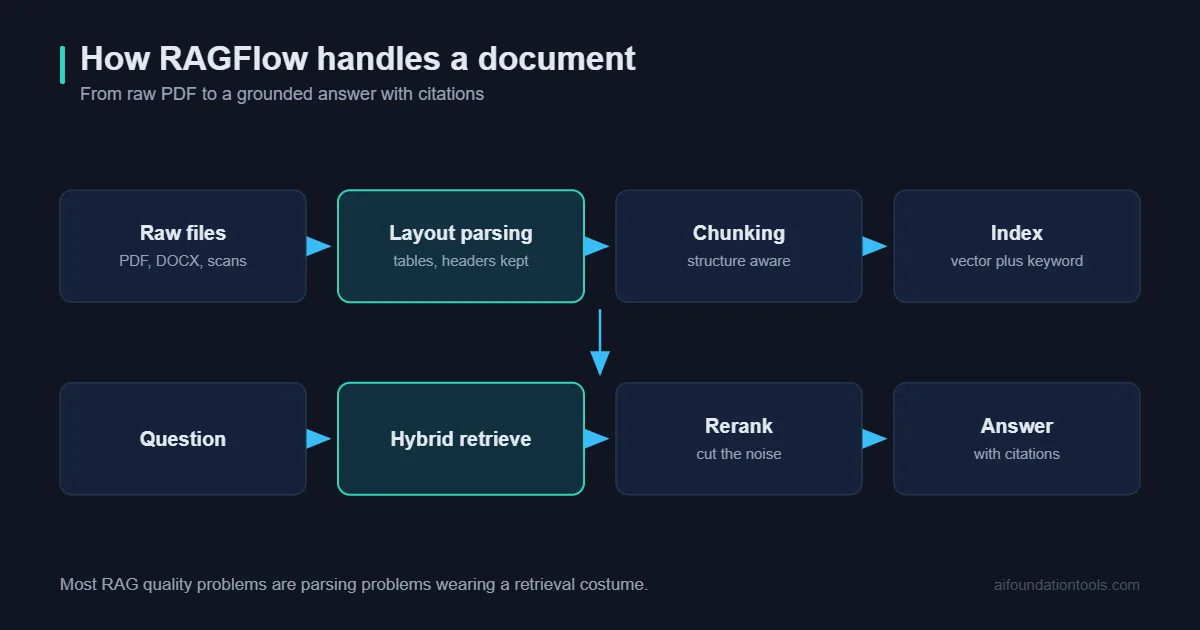
Four steps: your documents get processed and indexed; a question arrives; the system retrieves the most relevant pieces; the model answers using those pieces as its source.
The appeal is obvious. No retraining. Update a document and the answer updates. And because you know which passages were used, answers can be cited and verified – which is exactly what a fine-tuned model cannot offer.
The catch is equally obvious once you have built one. Every stage depends on the stage before it, and the earliest stage – reading the document – is where most systems quietly fail.
What Makes RAGFlow Different
Three design decisions separate RAGFlow from a generic RAG stack.
It treats parsing as a vision problem. Rather than extracting text and hoping, RAGFlow analyses the visual layout of a page – where the boxes are, which regions are tables, what the reading order should be. This is slower and dramatically more accurate.
It chunks by document type, not by token count. A contract, a slide deck and a spreadsheet get different treatment because they have genuinely different structures. Most pipelines apply one splitter to everything.
It shows its working. Every answer traces back to the specific chunk that produced it, and you can inspect exactly how each document was parsed. When something goes wrong, you can see where – which sounds minor until you have spent a week debugging a black box.
None of this is glamorous. It is, however, the difference between a system people trust and one they quietly stop using.
Inside Deep Document Understanding
DeepDoc is the component doing this work, and it runs several kinds of analysis on every page.
Optical character recognition reads text from images and scanned pages, so a photographed invoice becomes searchable rather than invisible.
Layout recognition identifies the regions of a page – title, body, caption, header, footer, figure – and works out the correct reading order. This is what stops a two-column paper from interleaving into gibberish.
Table structure recognition reconstructs rows, columns and merged cells so that a number keeps its relationship to its row label and column header. Ask a system without this which supplier charges most for a given part and it will confidently return a number from the wrong row.
The practical consequence: RAGFlow can ingest the documents organisations actually have – scanned, multi-column, table-heavy, occasionally rotated – rather than the clean documents demos are built on. Recent versions support GPU acceleration for this stage, which addressed the main historical objection that thorough parsing was too slow at volume.
The Pipeline, Stage by Stage
- Ingestion. PDFs, Word files, presentations, spreadsheets, images, web pages.
- Deep parsing. OCR, layout analysis and table reconstruction preserve structure.
- Template chunking. Splitting follows the document’s own logic – by clause, by slide, by section.
- Indexing. Chunks are embedded and stored for semantic search, optionally with keyword indexing alongside. The trade-offs at this layer are covered in our guide to vector databases for RAG.
- Retrieval. Hybrid search combines meaning and exact terms, then reranking picks the strongest candidates.
- Generation. The model answers from the retrieved context, with citations attached.
Notice that four of six stages happen before the model is involved. That distribution is the point.
Knowledge Graphs and When They Help
RAGFlow can build a knowledge graph across a dataset, mapping entities and the relationships between them rather than relying on similarity alone. The graph is constructed across the whole dataset rather than per file, and updates as new documents are parsed.
This matters for questions that require connecting information scattered across many documents – which projects a particular person touched, which agreements reference a discontinued product. Pure similarity search struggles here because no single chunk contains the answer.
It is not free. Graph construction adds significant processing time, and for straightforward lookup questions it adds nothing. Enable it when your questions are genuinely relational; leave it off otherwise.
How It Compares to Other Approaches
| Approach | Document handling | Setup effort | Citations | Data location |
|---|---|---|---|---|
| RAGFlow | Deep parsing, OCR, tables | Moderate | Built in | Yours |
| Upload to a chatbot | Basic text extraction | None | Limited | Vendor |
| DIY framework stack | Whatever you build | High | You build it | Yours |
| Managed RAG service | Varies, often shallow | Low | Varies | Vendor |
| Fine-tuning a model | Not applicable | Very high | None | Depends |
The RAGFlow repository documents the supported index and parsing options in detail. Fine-tuning deserves a note because it is still proposed as an alternative. It is not one. Fine-tuning teaches a model style and format; it does not reliably teach facts, it cannot cite sources, and updating anything means retraining. For factual grounding, retrieval wins on every axis that matters.
Where It Earns Its Keep
Internal knowledge assistants. Policies, procedures, onboarding material. The classic first deployment, and the one with the best success rate.
Contract and document review. Structural questions across hundreds of agreements. This is where table and clause preservation stops being a nice detail and becomes the whole value.
Technical support. Manuals, specifications and past resolutions, retrieved when a ticket arrives so an engineer starts with context instead of a search box.
Research synthesis. Academic papers and reports, where the Paper chunking method understands abstracts, sections and references as distinct things.
Regulated environments. Anywhere documents cannot leave your infrastructure and every claim needs a traceable source. Self-hosting plus citations is a combination few managed services can match.
To move these from manual chat interactions to automated workflows, most teams connect RAGFlow to an orchestration layer – the patterns in our guide to n8n AI agents apply directly.
Five Document Types That Break Everything Else
The clearest way to understand what RAGFlow is for is to look at the files that defeat simpler pipelines.
The scanned contract. Someone signed a paper agreement in 2019 and photographed it. There is no text layer at all. A standard extractor returns an empty string and the system reports, technically correctly, that it found nothing. RAGFlow runs OCR first, so the document becomes searchable rather than silently absent from every answer.
The financial statement. Nested tables, merged cells, footnotes tied to specific rows. Flattened into text, a revenue figure loses its association with both its year and its business unit. Ask which division grew fastest and you get a number pulled from nowhere in particular. Table structure recognition is the only thing that prevents this, and it is why RAGFlow performs so differently on finance documents than general-purpose tools.
The academic paper. Two columns, an abstract, figures with captions, a reference list. Read naively, the columns interleave line by line and the resulting text is genuinely meaningless. Layout analysis establishes reading order before any chunking happens.
The equipment manual. Diagrams with callouts, procedural steps, safety warnings in boxes. The structure carries meaning – a warning belongs to the step beside it, not to the page. Template chunking in RAGFlow keeps those relationships intact.
The slide deck. Each slide is a self-contained thought with almost no connective prose. Split by token count and you get fragments of three unrelated slides in one chunk. Split by slide and each chunk is coherent.
If none of your documents look like these, you probably do not need RAGFlow. If several do, this list is the whole argument.
What to Measure Before and After
Claims about retrieval quality are easy to make and hard to verify, so measure your own.
Build a set of fifty questions drawn from real users, each with a known correct answer and a known source document. Then track three numbers.
Retrieval hit rate. How often the correct source chunk appears among the retrieved candidates. This isolates retrieval from generation and is the number most worth improving first.
Answer accuracy. How often the final response is correct and properly sourced. Judged by a human, ideally one who did not build the system.
Refusal correctness. How often it says “not in these documents” when the answer genuinely is not there. A system that never refuses is not being honest, it is guessing well.
Run the set before you change anything, then after each significant adjustment. Teams that do this find that RAGFlow improvements come from parsing and chunking far more often than from model upgrades – which is the opposite of where most budget gets spent.
Where RAGFlow Sits in a Wider Stack
It is rarely the only component. A realistic setup has three layers around it.
Above it, an interface. Chat is the obvious one, but the more valuable integrations are ambient – a Slack bot, a sidebar in an internal tool, a step inside an existing workflow. People use what is already in front of them.
Beside it, automation. Documents need to arrive without anyone uploading them, and answers need to trigger actions. This is where an orchestration layer earns its place: watch a folder, parse on arrival, route the result. Our guides to n8n as an automation platform and self-hosting it properly cover the mechanics.
Below it, infrastructure you actually maintain. Backups, monitoring, version pinning, someone whose job includes noticing when parsing has been failing for a week.
The common mistake is treating RAGFlow as a finished product rather than an engine. It handles the hardest technical part of the problem well and leaves the surrounding system to you. Teams that plan for that build something durable; teams that expect a turnkey assistant tend to stall about a month in.
Honest Limitations
Parsing quality costs time. Thorough analysis is slower than naive extraction. GPU acceleration helps; it does not make it instant.
It is real infrastructure. Several containers, meaningful memory requirements, ongoing maintenance. This is not a library you import.
Retrieval still needs tuning. Excellent parsing gives you a much better starting point, not a finished system. Chunking strategy and retrieval parameters still want iteration against a real question set.
Overkill for small clean corpora. A few hundred tidy text files do not justify the operational weight.
Rapid development has costs. Features arrive quickly, documentation lags, and occasional releases break things. Pin versions in production.
Who Should and Should Not Use It
A short section, because the wrong-fit deployments are predictable.
RAGFlow makes sense if your documents are visually complex, your corpus runs to thousands of files rather than dozens, your data cannot leave your infrastructure, or answers need to be traceable to a source for compliance reasons. Any two of those together and it is a strong candidate.
RAGFlow is the wrong choice if you have a few hundred clean markdown files, nobody available to maintain infrastructure, or you need something live this afternoon with no ongoing owner. In those cases a lighter tool will serve you better and you will not miss the parsing sophistication.
There is also a middle case worth naming: teams who genuinely need deep document understanding but have no operational capacity. The managed cloud option exists precisely for them, and choosing it is not a failure of ambition. Running RAGFlow badly is worse than not running it.
One last piece of advice that applies regardless. Before committing to any retrieval engine, take the five worst documents in your organisation – the scanned one, the enormous spreadsheet, the badly formatted manual – and parse them. Read the output. That fifteen-minute test predicts your outcome better than every feature comparison you will read, including this article.
Frequently Asked Questions
Is RAGFlow open source?
Yes, and it can be self-hosted entirely on your own infrastructure. A managed cloud option exists for teams that prefer not to operate it.
Does it replace a vector database?
It includes the storage and retrieval you need to start, so nothing separate is required. Teams with existing infrastructure sometimes integrate their own.
Which models does it work with?
Hosted providers and local model servers both. Running local keeps the entire pipeline inside your network.
How accurate is the table extraction?
Considerably better than standard text extraction, which is a low bar it clears comfortably. Very unusual layouts still need checking – verify against your own worst documents rather than trusting any benchmark.
Can it handle scanned documents?
Yes, through OCR. Quality depends on scan quality, as it always does.
Where should I start?
With a small document set and default settings. Our step-by-step beginner guide walks through the first deployment, and our look at RAGFlow in enterprise use covers the strategic case. The GitHub repository and official docs are the primary references.
Final Thoughts
There is a pattern in AI tooling where the unglamorous problems get solved last, because nobody demos a document parser. Retrieval quality has quietly been the difference between AI projects that survive and AI projects that get quietly shelved, and it almost never comes down to the model.
RAGFlow is worth attention because it committed to the unfashionable half of the problem. It is not the lightest option, and it is not the right choice for a small clean corpus. But if your documents look like the ones real organisations produce – scanned, tabular, inconsistently formatted, occasionally a photograph of a page – then reading them properly is not a detail. It is the job.
Test it on your worst document, not your best one. That single test will tell you more than any comparison table, including the one above.