
Table of Contents
- Why RAGFlow Is Suddenly Everywhere
- DeepDoc: The Part Competitors Keep Underestimating
- What Changed in RAGFlow During 2026
- How the Architecture Actually Fits Together
- RAGFlow vs Building It Yourself vs Managed Platforms
- Why Enterprises Keep Landing Here
- Deployment: What It Really Takes
- Where RAGFlow Falls Short
- Three Deployment Patterns That Work
- An Evaluation Checklist
- Five Mistakes to Avoid
- A Realistic Cost Picture
- Frequently Asked Questions
- Final Thoughts

There is a specific moment in every enterprise AI project where the enthusiasm drains out of the room. It happens when somebody uploads a real document – a 200-page contract with nested tables, a scanned invoice, a technical manual with diagrams – and the beautiful prototype returns an answer that is confidently, obviously wrong.
That moment is why RAGFlow exists, and it is why the project crossed roughly 70,000 GitHub stars by the middle of 2026 to become one of the fastest-growing open-source projects in the AI space.
Most retrieval-augmented generation stacks fail at the boring end: reading documents properly. RAGFlow was built by people who decided that problem was worth solving first, and everything else second. That single design choice explains most of its adoption.
Why RAGFlow Is Suddenly Everywhere
Three things converged.
Enterprises ran out of patience with demos. The 2024-2025 wave of RAG prototypes largely did not survive contact with real document sets. Companies that had already spent a year on internal assistants started looking for something that handled messy PDFs out of the box rather than something they had to teach.
Open source stopped being the compromise option. Self-hosting an engine like RAGFlow now means keeping sensitive documents inside your own network without accepting a meaningful capability gap. For regulated industries that is not a preference, it is a requirement.
The project shipped relentlessly. RAGFlow moved from basic retrieval to knowledge graphs, agent workflows and memory management in roughly eighteen months. Few competing open-source projects kept that pace.
DeepDoc: The Part Competitors Keep Underestimating
If you take one thing from this article, take this: RAGFlow treats document parsing as a vision problem, not a text extraction problem.
Most pipelines run a PDF through a text extractor, get back a flat stream of characters, and chunk it at 512 tokens. Tables become word soup. Headers detach from the sections they describe. Multi-column layouts interleave into nonsense. The retrieval layer then does an excellent job of finding the wrong thing.
DeepDoc, the proprietary document understanding system inside RAGFlow, performs OCR, table structure recognition and layout analysis to preserve the semantic structure of the original. A table stays a table. A heading stays attached to its content. A two-column academic paper reads in the right order.
This matters more than any model choice. You can pair a mediocre model with well-parsed documents and get useful answers. Pair a frontier model with mangled documents and you get fluent nonsense. RAGFlow optimises for the half of the equation most teams ignore.
DeepDoc now supports GPU acceleration, which addresses the main historical complaint – that high-quality parsing was slow on large document sets.
What Changed in RAGFlow During 2026
The releases through 2026 pushed the project well past its original scope.
Memory management. Version 0.24.0, released in February 2026, introduced memory management APIs alongside knowledge base governance. RAGFlow can now extract and store semantic, episodic and working memory from conversations – which turns a question-answering system into something that accumulates context across sessions.
Knowledge base governance. The same release added the controls enterprises actually ask about in procurement: who can see which knowledge base, how content is curated, how updates propagate.
Dataset-level GraphRAG. Knowledge graphs are now built across an entire dataset rather than per file, and update automatically when new files are parsed. This is the difference between a graph that knows your company and a graph that knows one document.
Agent components. RAGFlow added a Browser component that lets an agent navigate and interact with web pages, an Iteration component for looping work, and a research report generator template. The project is deliberately blurring the line between a retrieval engine and an agent platform.
How the Architecture Actually Fits Together
Five layers, in order.
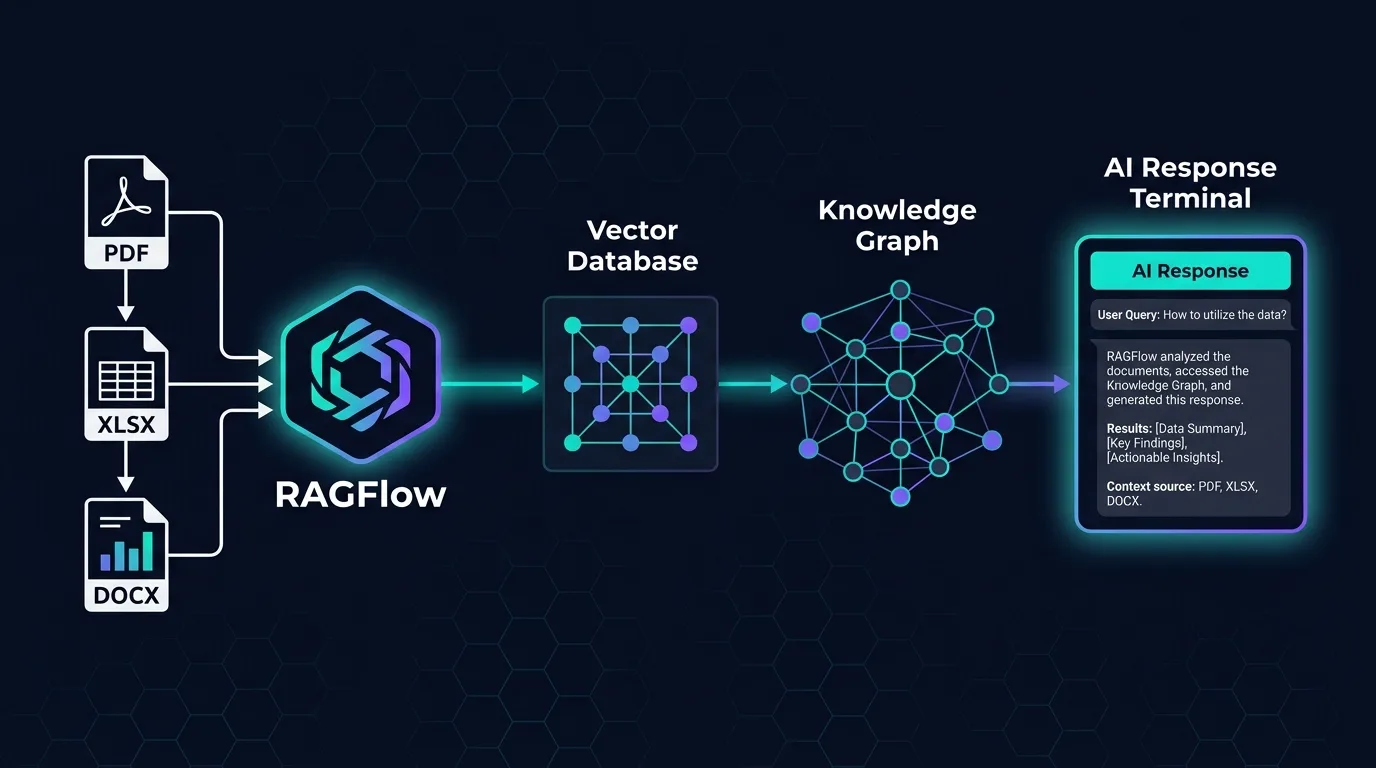
- Ingestion. Documents arrive – PDF, DOCX, PPTX, spreadsheets, images, web pages.
- DeepDoc parsing. Layout, tables and reading order are recognised and preserved.
- Template-based chunking. RAGFlow offers chunking templates matched to document type rather than one blind splitter. A legal contract and a product manual do not want the same treatment.
- Indexing. Chunks are embedded and stored, with optional knowledge graph construction on top. If you are choosing what sits underneath this layer, our guide to vector databases for RAG covers the trade-offs.
- Retrieval and generation. Hybrid retrieval, reranking, then the model, with citations traced back to the source chunk.
The citation behaviour deserves a mention on its own. RAGFlow shows which chunk produced which claim, which means a reviewer can verify an answer in seconds. In regulated environments that traceability is often the feature that gets the project approved.
RAGFlow vs Building It Yourself vs Managed Platforms
| Approach | Time to production | Document handling | Data control | Best for |
|---|---|---|---|---|
| RAGFlow | Days to weeks | Excellent out of the box | Full – self-hosted | Teams with complex documents and privacy needs |
| Custom LangChain / LlamaIndex | Weeks to months | Whatever you build | Full | Products where retrieval is the differentiator |
| Managed RAG SaaS | Hours | Varies, often shallow | Vendor-dependent | Simple corpora, no compliance constraints |
| Model provider file search | Minutes | Basic | None | Prototypes and small internal tools |
The honest read: if your documents are clean text and your corpus is small, you do not need RAGFlow. If your documents are the messy artefacts real organisations actually produce, the parsing quality is worth the operational overhead on its own.
Why Enterprises Keep Landing Here
Talk to teams that chose RAGFlow and the same four reasons come up.
Documents never leave. Self-hosted deployment means contracts, patient records and financial statements stay inside the perimeter. No data processing agreement negotiation, no residency questions.
Answers are auditable. Citation-backed responses mean a compliance officer can trace any claim to a source page. “The AI said so” is not an acceptable answer in a regulated review; “page 47 of this contract said so” is.
No per-query billing. Costs scale with infrastructure rather than with usage, which changes the internal politics of adoption. Teams stop rationing queries.
It handles the hard formats. Scanned documents, complex tables, mixed-language files. This is where most alternatives quietly fail.
Common deployments look like internal knowledge assistants, contract analysis, customer support augmentation and research synthesis. If you want to trigger these workflows automatically rather than through a chat window, pairing RAGFlow with n8n AI agents is the pattern most teams settle on.
Deployment: What It Really Takes
RAGFlow ships as a Docker Compose stack, which makes a first deployment genuinely easy and a production deployment genuinely a project.
Hardware. Plan for at least 4 CPU cores and 16GB RAM to evaluate. Real workloads want considerably more, and a GPU meaningfully speeds up DeepDoc parsing on large document sets.
Storage. Parsed documents, embeddings and knowledge graphs all consume space. Budget several times the size of your raw corpus.
Models. RAGFlow connects to hosted providers or local models such as those served by Ollama. Local keeps everything internal but shifts the hardware burden onto you.
Operations. Backups, monitoring, upgrades. The project moves fast, which is a benefit and a maintenance obligation at the same time. If self-hosting infrastructure is new to your team, the sizing logic in our n8n self-hosting guide transfers directly.
A realistic timeline: an afternoon to a working demo, two to four weeks to something a department depends on.
Where RAGFlow Falls Short
No tool review is worth reading without this section.
It is heavier than it looks. The Docker stack pulls in several services. This is not a pip install.
The pace cuts both ways. Rapid releases mean features arrive quickly and occasionally break. Pin your version in production and upgrade deliberately.
Documentation trails the code. Newer capabilities are sometimes better explained in release notes and GitHub issues than in the docs.
Tuning is still your job. RAGFlow gives you excellent parsing and sensible defaults. Chunking strategy, retrieval parameters and reranking still need iteration against your own evaluation set.
It is not a small-corpus tool. For a few hundred clean documents, the operational weight is not justified.
Three Deployment Patterns That Actually Work
Abstract advice is easy. Here is what successful rollouts tend to look like in practice.
The Department Knowledge Base
The most common starting point, and the one with the highest success rate. One team – legal, HR, support, engineering – indexes the documents they answer questions about all day. Fifty to five thousand files. A chat interface, a Slack integration, nothing more ambitious.
It works because the scope is small enough to evaluate honestly. The people using it wrote most of the source documents, so they spot a wrong answer immediately. That feedback loop is what turns a demo into something trusted, and it is almost impossible to get at company-wide scale on day one.
The Contract and Compliance Reviewer
Legal and procurement teams index executed agreements, then ask structural questions across the whole set: which contracts auto-renew this quarter, which lack a liability cap, which reference a jurisdiction the business no longer operates in.
This pattern depends entirely on parsing quality. A contract is nested clauses, cross-references and tables – exactly the structure that flat text extraction destroys. It is the clearest case where document understanding is the whole product, and where cheaper alternatives visibly fail.
The Support Augmentation Layer
Not a customer-facing bot. An internal one. When a ticket arrives, the system retrieves the relevant documentation, past resolutions and product specs, then hands the agent a summary with citations.
The reason this works better than customer-facing deployment is accountability. A human reads the output before anyone acts on it, so a wrong retrieval costs thirty seconds instead of trust. Teams that start here and move outward do better than teams that start with a public chatbot.
An Evaluation Checklist Before You Commit
Run through this before the pilot, not after.
- Take your ugliest document. Not a clean sample. The scanned one with rotated tables and a coffee stain. Parse it first. This single test predicts more about your outcome than any benchmark.
- Write fifty real questions. With known correct answers, sourced from actual users rather than invented by the project team. This becomes your evaluation set, and without it you are tuning by vibes.
- Decide your privacy line now. Whether embeddings and prompts may leave your network is an architecture decision, not a preference to revisit later.
- Estimate corpus growth. Not today’s document count – the count in eighteen months. Storage and index rebuild times scale with it.
- Name an owner. Self-hosted infrastructure without a named maintainer becomes shadow IT within two quarters.
- Agree what failure looks like. A defined accuracy threshold beats “it feels about right” when the project is reviewed.
Five Mistakes That Undermine Good Deployments
1. Indexing everything on day one. Dumping the entire shared drive in produces a system that retrieves outdated policies with total confidence. Curate first. Stale documents are worse than missing ones, because nobody questions a confident citation.
2. Skipping the chunking templates. The template system exists because a legal contract and a slide deck need different treatment. Using the default splitter for everything throws away the main advantage of the parsing layer.
3. Treating retrieval quality as a model problem. When answers are poor, teams reach for a bigger model. The cause is almost always chunking, parsing or the absence of reranking. A better model on bad context produces more articulate errors, not fewer.
4. No feedback mechanism. A thumbs-down button that writes the question and the retrieved chunks to a log is perhaps two hours of work, and it is the difference between improving deliberately and guessing.
5. Launching company-wide. Broad rollouts fail loudly and poison the well for the next attempt. One department, three months, measurable results, then expand. RAGFlow rewards patience here more than most software does.
A Realistic Cost Picture
The software is free. The total cost is not, and it splits three ways.
Infrastructure. A modest evaluation deployment runs on a mid-tier server. Production with a large corpus and GPU-accelerated parsing is meaningfully more. This is predictable and easy to budget.
Inference. Hosted models bill per token, so cost tracks usage. Local models move that spend into hardware you own. Neither is universally cheaper – it depends on volume and how idle your hardware would otherwise be.
People. The one that gets omitted from business cases. Someone maintains this. Someone curates the knowledge base. Someone investigates when a department reports bad answers. Budget a fraction of an engineer indefinitely, not a one-off setup effort.
Compared against a per-seat commercial platform, self-hosting usually wins on a three-year view and loses on a three-month one. Which horizon you are optimising for should decide the question.
Frequently Asked Questions
Is RAGFlow free?
The core engine is open source and free to self-host. You pay for infrastructure and, if you use hosted models, for inference. A managed cloud option exists for teams that would rather not run it themselves.
How does RAGFlow compare to LangChain?
They solve different problems. LangChain is a framework for building pipelines; RAGFlow is a working application you deploy. If you want a retrieval system next week, RAGFlow. If retrieval logic is your product, build it.
Can it work with local models?
Yes. RAGFlow connects to local model servers, so a fully air-gapped deployment is achievable if your compliance posture requires it.
What document formats does it handle?
PDF, Word, PowerPoint, Excel, images, text, markdown, HTML and web pages, including scanned documents through OCR.
Do I still need a separate vector database?
RAGFlow includes storage, so no separate system is required to start. Teams with existing infrastructure sometimes integrate one anyway – our vector database comparison covers when that is worth doing.
Where should a beginner start?
Deploy locally with a small document set before touching configuration. Our RAGFlow beginner guide walks through the first deployment, and the official documentation and GitHub repository are both actively maintained.
Final Thoughts
The interesting thing about RAGFlow is not that it is the most sophisticated retrieval engine available. It is that it made an unfashionable bet – that document understanding matters more than clever retrieval tricks – and that bet turned out to be correct.
Enterprise AI projects do not usually fail because the model was not smart enough. They fail because the system was reading the documents badly and nobody noticed until it embarrassed someone in a meeting.
If your documents are clean and few, use something lighter. If they are the sprawling, scanned, table-heavy reality of an actual organisation, RAGFlow is the most credible open-source answer available right now – and the fact that you can run the whole thing inside your own network is what keeps putting it on the shortlist.
Sources and Further Reading
- RAGFlow on GitHub, the official repository and documentation
Related on this site: RAG 101 and vector databases for RAG.