


Table of Contents
- The Shape of a Modern Pipeline
- Ingestion: Getting Data In
- Transformation: Making It Usable
- Orchestration: Making It Run
- Streaming and Change Data Capture
- The Twelve at a Glance
- Three Stacks That Actually Work
- What Changed in the Last Two Years
- Where the Money Actually Goes
- Build or Buy, Honestly
- How to Choose Without Overbuilding
- Seven Mistakes That Create Pipeline Debt
- Four Signals Your Pipeline Is Healthy
- Frequently Asked Questions
- Final Thoughts
The most useful thing to understand about data pipeline tools in 2026 is that you are not choosing one. You are assembling two or three, and the industry settled on this some time ago even though most comparison articles still present it as a single choice.
The monolithic platform that ingests, transforms, orchestrates and monitors is largely gone. What replaced it is a composable stack where each tool does one job properly, which is better in almost every way except for the fact that it makes the buying decision harder.

The Shape of a Modern Data Pipeline
A data pipeline has four stages, and knowing which one a tool belongs to eliminates most of the confusion.
Ingestion. Moving raw data from wherever it lives – SaaS apps, production databases, APIs, files – into a central store. This used to be the hard part and is now largely a solved, purchasable problem.
Storage. A warehouse or lakehouse. This is your architectural centre of gravity, and it constrains everything else.
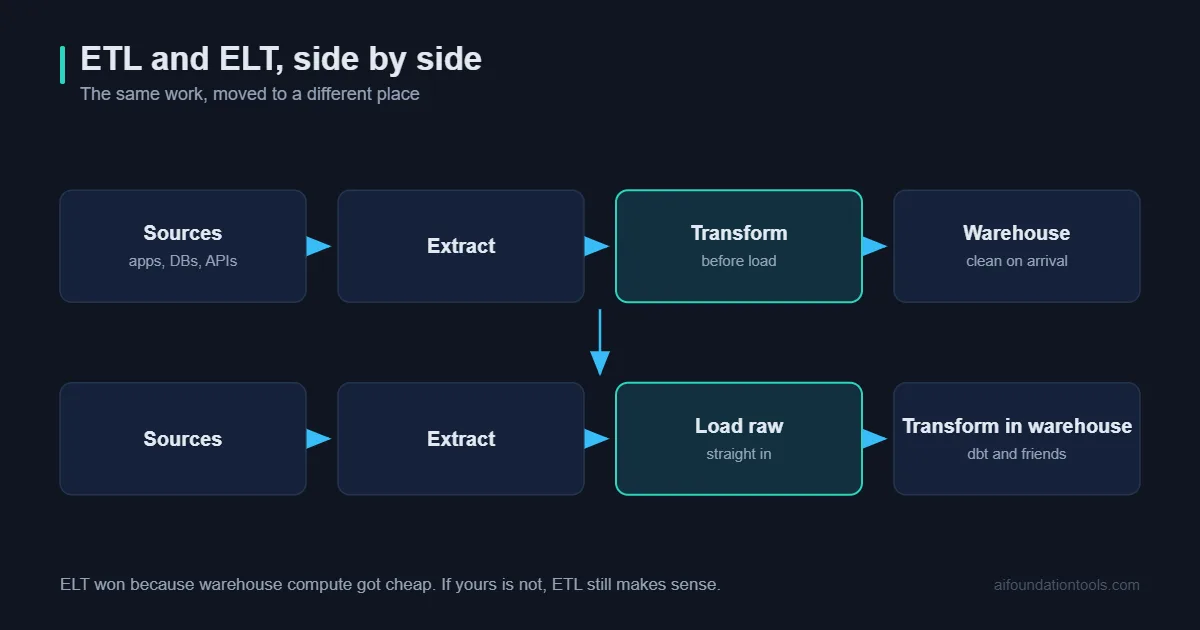
Transformation. Turning raw loaded data into models people can actually query. Increasingly this happens inside the warehouse rather than before loading, which is the shift from ETL to ELT.
Orchestration. Deciding what runs, when, in what order, and what happens when something fails. The stage teams underestimate most consistently.
Most stacks pick one tool per stage. Nearly all production setups combine two or three of these categories rather than relying on any single platform.
Data Pipeline Tools for Ingestion
1. Fivetran
The managed default. Hundreds of connectors, schema drift handled automatically, essentially no maintenance. If your priority is fast onboarding with minimal ongoing work, this is one of the safest choices available.
The trade: consumption pricing that can escalate sharply as volumes grow, and you are dependent on their connector roadmap for anything niche.
2. Airbyte
The open-source answer. A very large connector catalogue, self-hostable, and you can write your own connector when one does not exist.
The trade: connector quality varies because many are community-maintained, and self-hosting means you own the reliability.
3. Estuary
Built around streaming and change data capture rather than batch, which makes it the option when freshness genuinely matters rather than being a preference.
4. Meltano
Open source, built on the Singer taps ecosystem, configuration as code. Appeals to teams who want their whole pipeline in version control.
Data Pipeline Tools for Transformation
5. dbt
The clear standard for in-warehouse transformation, and one of the few genuinely uncontested positions among data pipeline tools.
The reason it won is not the SQL compilation – it is that it brought software engineering practice to analytics. Version control, testing, documentation, lineage, modularity. Before dbt, transformation logic lived in scheduled queries nobody could review.
The trade: SQL-only by design. Complex logic that would be simple in Python becomes awkward.
6. SQLMesh
The most credible challenger. Column-level lineage, proper virtual data environments, and change categorisation that avoids rebuilding everything when you edit one model.
The trade: a much smaller ecosystem. Choosing it means fewer people who already know it.
Data Pipeline Tools for Orchestration
7. Apache Airflow
Still dominant, and for good reason: enormous ecosystem, every integration exists, and finding people who know it is trivial.
The trade: it orchestrates tasks rather than data. Airflow knows a job ran; it does not know what that job produced. Local development remains awkward.
8. Dagster
The fastest-growing alternative, built around a genuinely different idea: it orchestrates assets rather than tasks. You declare what should exist – this table, this model, this report – and Dagster works out what needs to run.
That distinction sounds academic and is not. Asset-aware orchestration gives you lineage, freshness policies and partial rebuilds for free.
The trade: the mental model takes adjustment if you have years of task-based thinking, and the ecosystem is smaller.
9. Prefect
The most Python-native of the three. Pipelines are decorated Python functions, dynamic workflows are straightforward, and local development is genuinely pleasant.
The trade: fewer opinions means less structure. Teams that want guardrails may find it too permissive.
10. Mage
A lighter, notebook-influenced option aimed at smaller teams who find Airflow disproportionate to their problem. Good for getting something running quickly; less proven at scale.
Streaming and Change Data Capture
11. Apache Kafka
The backbone for event streaming at scale. Not really a pipeline tool so much as the substrate real-time pipelines are built on.
The trade: operationally serious. Running Kafka properly is somebody’s job.
12. Debezium
Change data capture done properly – it reads your database’s transaction log and emits every change as an event, without polling or timestamp columns.
Pairs with Kafka in most deployments. The right answer when you need your warehouse to reflect production within seconds rather than hours.
The Twelve at a Glance
| Tool | Stage | Model | Best for |
|---|---|---|---|
| Fivetran | Ingestion | Managed | Teams who want zero maintenance |
| Airbyte | Ingestion | Open source | Custom connectors, cost control |
| Estuary | Ingestion | Managed | Real-time freshness |
| Meltano | Ingestion | Open source | Everything in version control |
| dbt | Transformation | Both | Almost everyone |
| SQLMesh | Transformation | Open source | Large models, costly rebuilds |
| Airflow | Orchestration | Open source | Complex dependencies, big teams |
| Dagster | Orchestration | Both | Asset lineage, data awareness |
| Prefect | Orchestration | Both | Python-heavy, dynamic workflows |
| Mage | Orchestration | Open source | Small teams starting out |
| Kafka | Streaming | Open source | Event-driven at scale |
| Debezium | CDC | Open source | Near-real-time database sync |
Three Data Pipeline Stacks That Work
The default modern stack. Fivetran or Airbyte for ingestion, a cloud warehouse for storage, dbt for transformation, Airflow or Dagster triggering dbt after ingestion completes. This covers the overwhelming majority of analytics workloads and is the pattern most teams converge on.
The lean stack. Airbyte self-hosted, a warehouse, dbt Core, and either Dagster or a scheduler. Almost no licence cost, more of your own time. Right for small teams and startups.
The real-time stack. Debezium and Kafka for change capture, streaming ingestion, transformation on arrival, orchestration for the batch work that remains. Considerably more operational weight – only justified when freshness is a genuine requirement rather than a nice-to-have.
Note the pattern: every one of these combines several data pipeline tools. Anyone selling you a single platform that does all four stages well is describing an ambition rather than a product.
What Changed in the Last Two Years
Three shifts explain why advice written in 2023 now points you at the wrong architecture.
Ingestion became a commodity. Writing connectors used to be most of the work. It is now a purchasing decision, and the interesting questions moved downstream to transformation and orchestration. If a comparison of data pipeline tools spends most of its length on connectors, it is solving a problem you no longer have.
Orchestration got opinions. For years, orchestration meant Airflow and the debate was about deployment. Dagster’s asset-based model introduced a genuinely different way of thinking – declare what should exist rather than what should run – and it forced the whole category to get more specific about what it is orchestrating.
The warehouse absorbed everything. Transformation, then Python, then increasingly the workloads described in our chunking guide. Transformation moved inside it. Then Python, then notebooks, then increasingly ML workloads. The warehouse stopped being where data rests and became where work happens, which is why choosing it constrains every other decision in your stack.
The practical consequence: evaluate data pipeline tools by how well they fit around your warehouse, not in isolation.
Cost: Where the Money Actually Goes
Budgets for data pipeline tools are usually wrong in the same direction, because the licence is the visible part and rarely the largest.
Ingestion pricing scales with rows. Managed ELT typically charges by volume, and volume grows faster than anyone forecasts. A connector that is trivially cheap in year one can be a meaningful line item by year two. Model it against projected growth, not current usage.
Warehouse compute is usually the biggest number. Not ingestion, not orchestration – the queries. Badly written transformations that rebuild everything nightly cost far more than the tools that trigger them. This is where incremental models earn their keep.
Engineering time is the hidden line. Self-hosting to save on licences is only a saving if nobody’s week disappears into it. Price your own hours honestly before choosing open source on cost grounds.
Failure has a cost too. A pipeline that silently stops for a fortnight means decisions made on stale numbers. That rarely appears in any comparison and is frequently the most expensive thing that happens.
Build or Buy, Honestly
The instinct to build is strong among engineers and usually wrong for ingestion.
Buy ingestion unless your sources are genuinely unusual. Connector maintenance is endless, unrewarding, and breaks whenever an upstream API changes without notice.
Own transformation. This is your business logic. It should live in your repository, be reviewed like code, and never depend on a vendor’s proprietary format.
It depends on orchestration. Managed removes operational burden; self-hosted gives control and avoids per-run pricing. Either is defensible.
The reasonable default for most teams: buy the parts that are undifferentiated, own the parts that encode how your business thinks. Data pipeline tools that try to own your business logic are the ones to be most cautious about, because that is the layer that makes migration painful later.
How to Choose Data Pipeline Tools Without Overbuilding
Work down this list and stop when you have enough.
- Do you actually need a pipeline? If you have three data sources and a weekly report, scheduled scripts and a warehouse may be sufficient. Plenty of teams build infrastructure for scale they never reach.
- How fresh does data need to be? Daily is a different architecture from sub-minute. Be honest – most “real-time” requirements are hourly requirements with impatience attached.
- Buy or build ingestion? If your sources are common SaaS tools, buy. Writing and maintaining connectors is unrewarding work.
- Is your team SQL or Python? This decides the transformation layer more than anything technical.
- Do you need lineage? If tracing why a number is wrong takes hours, asset-aware orchestration pays for itself quickly.
The most common failure among data pipeline tools is not choosing badly. It is choosing a stack sized for the company you hope to become, then maintaining it for years at your actual size.
Seven Data Pipeline Mistakes That Create Debt
1. No testing. Pipelines fail silently more often than loudly. Row counts, null checks and freshness assertions catch most of it and take an afternoon to add.
2. Transforming before loading. ELT exists because storage is cheap and reprocessing raw data is invaluable. If you transform on the way in, you cannot fix a mistake without re-ingesting.
3. One enormous job. A single script doing everything cannot be retried partially, debugged in isolation, or reasoned about. Split it.
4. No alerting on failures. Wiring alerts through an automation layer like n8n takes an afternoon. A pipeline that stopped three weeks ago and nobody noticed is worse than one that never existed, because people are trusting the stale numbers.
5. Undocumented business logic. The definition of “active customer” living only inside a SQL model is a decision nobody can find later.
6. Ignoring cost until the bill. Consumption-priced ingestion and warehouse compute both scale in ways that surprise people. Monitor from the start.
7. No owner. Data pipeline tools are infrastructure. Infrastructure without a named maintainer degrades quietly until it breaks loudly.
Four Signals Your Pipeline Is Healthy
Tool choice gets all the attention. Whether the thing works is a separate question, and these four signals answer it better than any architecture diagram.
Freshness is measured, not assumed. You should be able to say when each important table last updated, and be alerted when it does not. Most pipeline failures are discovered by a person noticing a number looks wrong, which is far too late.
Failures are loud. Every scheduled job that fails should notify someone by name. Silent failure is the defining characteristic of untrustworthy infrastructure.
Lineage is traceable. When a metric looks wrong, you should be able to walk backwards to the source in minutes. If that takes half a day, the cost compounds every time it happens.
Someone owns it. Not a team – a person. Shared ownership of data pipeline tools reliably means nobody notices when something has been broken for a fortnight.
A modest stack with all four beats a sophisticated one with none. The teams that trust their numbers are almost never the ones with the most impressive architecture.
Frequently Asked Questions
What is the difference between ETL and ELT?
ETL transforms data before loading it; ELT loads raw data first and transforms inside the warehouse. ELT is the modern default because storage is cheap and keeping raw data means you can always reprocess.
Do I need an orchestrator if I use dbt?
Not immediately. dbt Cloud can schedule jobs. You need an orchestrator once you have dependencies between systems – ingestion finishing before transformation starting, or downstream jobs waiting on both.
Airflow, Dagster or Prefect?
Our full Airflow vs Dagster vs Prefect comparison goes deeper. Airflow for large teams and maximum ecosystem. Dagster if data lineage matters. Prefect if your team is Python-first and wants flexibility. All three are production-grade.
Is Fivetran worth the cost?
If it replaces engineering time maintaining connectors, usually yes at moderate volume. At high volume the consumption pricing becomes the argument for Airbyte.
Can one person run a data pipeline?
Yes, with managed ingestion, a cloud warehouse and dbt. That combination is deliberately designed for small teams.
How do these relate to AI workloads?
Directly. A retrieval system needs a pipeline feeding it documents, and the storage layer overlaps with our guide to vector databases. A retrieval system needs a pipeline, and the same reliability concerns apply – our guide to retrieval-augmented generation covers what happens downstream of ingestion.
Final Thoughts
Data pipeline tools matured to the point where most of them are good. Fivetran will move your data. dbt will transform it. Airflow will schedule it. You are unlikely to fail because of a tool choice.
What you can fail at is building more pipeline than your organisation needs, or building one nobody owns. Both are considerably more common than picking the wrong orchestrator.
Start with the smallest data pipeline that answers your current questions. Add a stage when something specific hurts. That sequence produces infrastructure people trust, which is the only measure that matters.