
Table of Contents
- What Changes at This Budget
- The Parts List
- Why the RTX 5090
- What It Actually Runs
- The Power Supply
- Local AI Build Thermals at This Tier
- What 32B Models Change
- Planning for a Second Card
- Quantisation at 32GB
- Five Local AI Build Mistakes at This Tier
- The Local AI Build Against the Alternatives
- Local AI Build Assembly and First Setup
- What This Local AI Build Costs to Own
- Is the Step Up Worth It?
- Frequently Asked Questions
- Verdict
The two-and-a-half thousand dollar mark is where a local AI machine stops involving compromise. Below it you are choosing what to give up; above it you are paying steeply for capability most people never reach.
This local AI build sits at the point where the money buys capability rather than headroom you will not use.
What This Local AI Build Changes
One thing, and it is the thing that matters: 32GB of video memory instead of 16GB.
That doubling moves you from models around 14B parameters to comfortably running 32B at 4-bit quantisation on a single card. It is not an incremental speed gain — it is a different class of model, with noticeably better reasoning, longer coherent output and more reliable instruction following.
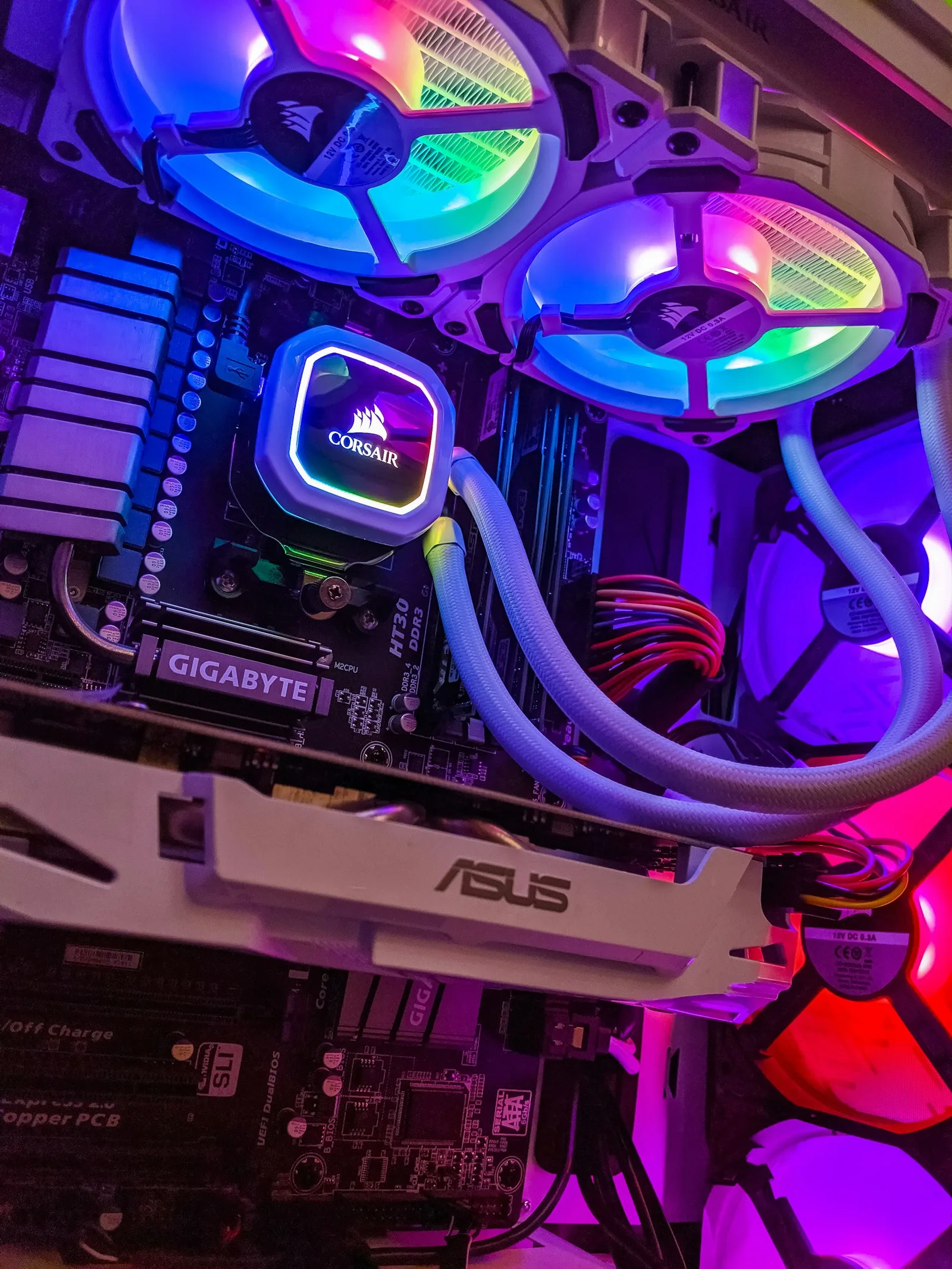
Everything else in this local AI build exists to keep that card fed and stable. The graphics card is the local AI build; the rest is support.
The Local AI Build Parts List
This is a graphics card with a computer attached. Specify accordingly.
| Component | What to get | Why | Link |
|---|---|---|---|
| Graphics card | RTX 5090 (32GB) | The entire point. 32B models on one card, and headroom to grow. | Check price |
| CPU | Current-gen 8 core | Still not the bottleneck. Sufficient, not extravagant. | Check price |
| Motherboard | B or X-series, good VRM, PCIe slot spacing | Spacing matters if a second card is ever likely. | Check price |
| System RAM | 64GB DDR5 (2×32GB) | Double the VRAM. Headroom for offloading and multiple models. | Check price |
| Power supply | 1000W+ 80 Plus Gold or better | Flagship cards spike hard. This is not the place to economise. | Check price |
| Storage | 2TB NVMe SSD | Larger models are large files. 1TB fills quickly at this tier. | Check price |
| Case | Full tower, mesh, high airflow | Flagship cards produce real heat under sustained load. | Check price |
| CPU cooler | 240mm AIO or large air tower | Keeps CPU thermals out of the equation entirely. | Check price |
| Case fans | 3–5 quality fans | Airflow is the difference between sustained and throttled. | Check price |
Component pricing moves constantly. Treat this as a specification to shop against rather than a fixed basket, and check current listings before committing.
Why the RTX 5090 Specifically
At this budget the alternative approaches are two 16GB cards, or one 32GB card. The single card wins for most people.
Simplicity. No splitting models across devices, no motherboard slot-spacing puzzle, no doubled heat in one case. Everything just works.
Power and noise. One flagship draws less and runs quieter than two mid-range cards doing equivalent work.
Upgrade path. Starting with one 5090 leaves the option of adding a second later for 64GB, which reaches 70B territory. Starting with two 16GB cards leaves you nowhere useful to go.
Our GPU guide by VRAM tier covers where each threshold sits, and the RTX 5080 breakdown explains what you gain by stepping up from 16GB.
What This Local AI Build Actually Runs
32B models at 4-bit, comfortably. This is the headline. These models are meaningfully more capable than the 14B class — better at multi-step reasoning, more reliable at following complex instructions, and noticeably better at code.
Long context without anxiety. 32GB means you are not constantly trading context length against model size, which is the tax you pay on 16GB.
Multiple models loaded. Keep a small fast model and a larger capable one available simultaneously, switching by task rather than reloading.
Serious image and video work. Full resolution generation without compromise, and video workflows that 16GB cards struggle with.
Fine-tuning small models. Genuinely feasible at this memory tier, which opens work that inference-only machines cannot do.
What it still does not run is 70B at 4-bit, which needs roughly 40GB for weights alone. That is the next tier up, and it means two cards.
The Power Supply, Again
It matters more here than in the budget build, not less.
Flagship cards draw heavily and spike sharply. Under inference that draw is sustained rather than bursty, which is a harder ask than gaming. A supply that seems generous on paper can prove marginal in practice.
Buy 1000W or more from a reputable manufacturer, and treat the specification as a floor rather than a target. If you might add a second card later, buy for that now, the supply is one of two components you cannot upgrade without rebuilding the local AI build.
Local AI Build Thermals at This Tier
A flagship card at sustained load produces genuine heat, and this is where full-tower cases earn their cost.
Three things worth doing. Mesh front panel, because glass restricts intake and this local AI build needs air. Positive pressure with more intake than exhaust, which keeps dust down over a machine that runs long jobs. And fan curves set deliberately, defaults are tuned for bursty gaming load and will let temperatures climb steadily under continuous inference.
The symptom of getting this wrong is subtle: not crashes, but token speed that declines over a long job as the card throttles. Easy to miss and easy to prevent.
What 32B Models Change in Practice
The jump from 14B to 32B is easy to state and hard to appreciate until you use it. Four places where the difference is obvious.
Multi-step reasoning. Ask a 14B model to work through a problem with several dependent steps and it frequently loses the thread partway. The 32B class holds it. This is the clearest single improvement and the reason people upgrade.
Code that runs. Smaller models produce plausible code with subtle errors. Larger ones produce code that works more often, and, more usefully, recognise when they are unsure rather than inventing an API that does not exist.
Long-document work. Summarising something substantial while retaining structure and nuance is where smaller models flatten everything into generic paragraphs. The extra capacity shows.
Instruction following under complexity. Give a model five constraints and a format requirement. The 14B class typically satisfies three. The 32B class usually satisfies all five, which is the difference between a tool you check and one you trust.
None of this makes the budget tier useless. It makes this tier feel like a different kind of tool rather than a faster version of the same one.
Planning for a Second Card
The most important decision in this local AI build is one you make now and act on later.
Two RTX 5090s give you 64GB, which reaches 70B at 4-bit, the tier most people eventually want and few plan for. Adding that second card is straightforward if the local AI build was specified for it, and requires a rebuild if it was not.
Three things to get right at build time. A power supply sized for two cards, because swapping it later means dismantling everything. A motherboard with genuine slot spacing, not just two slots on paper. Cards need physical room and airflow between them. A case that fits two cards with a gap, which rules out most mid towers.
Over-specifying all three costs modestly now. Retrofitting them costs more than the second graphics card. If a second GPU is even plausible within two years, build for it today.
Quantisation at 32GB
More memory changes the quantisation calculus in a way worth understanding.
On 16GB you are forced to 4-bit for anything mid-size. On 32GB you have genuine choices: a 32B model at 4-bit, or a 14B model at 8-bit with substantial context, or a smaller model at near-full precision.
The general rule still holds. a larger model at 4-bit beats a smaller model at 8-bit for the same footprint. But at 32GB the exceptions become real. If your work is precision-sensitive, running a mid-size model at higher precision is now an option rather than a fantasy.
This flexibility is an underrated part of what the money buys. You stop optimising around a constraint and start choosing based on the task.
Five Local AI Build Mistakes at This Tier
1. Pairing a flagship card with a mid-range power supply. The most common and most expensive error. Sustained inference draw is harder than gaming peaks.
2. A case chosen for looks. Glass fronts restrict intake. This card produces real heat for hours at a time.
3. Overspending on the CPU. Still not the bottleneck. That money buys nothing here.
4. Building without slot spacing. Forecloses the second-card upgrade for the sake of a cheaper motherboard.
5. Buying this tier before trying the cheaper one. A month on 16GB tells you whether you needed 32GB. Guessing costs considerably more than waiting.
The Local AI Build Against the Alternatives
| Approach | VRAM | Models at Q4 | Trade-off |
|---|---|---|---|
| Budget build (5060 Ti 16GB) | 16GB | Up to ~14B | Cheapest capable, slower |
| This local AI build (5090 32GB) | 32GB | Up to ~32B | Best capability per dollar at scale |
| Two × 5090 | 64GB | 70B | Doubles cost, adds complexity |
| Professional card | 96GB | 70B at FP16 | Business-tier pricing |
| Hosted API | n/a | Anything | Cheaper at low volume, no privacy |
Local AI Build Assembly and First Setup
Standard building, with four points that matter more on a machine running sustained load.
Seat the power connectors fully. Partially seated connectors on flagship cards are a documented cause of instability and worse. Check twice, and route the cable without tight bends near the connector.
Set fan curves deliberately. Defaults assume bursty gaming load. Under continuous inference they let temperatures climb until the card throttles, which shows up as token speed declining over a long job rather than as a crash.
Test with a real hour-long job. Not a benchmark. Short synthetic loads pass on machines that fail at forty minutes, and that failure mode is exactly what this local AI build is specified to avoid.
Then the software. A runner such as Ollama or LM Studio, one 32B model at 4-bit, used for real work for a week before adding anything else. Our guide to local LLMs by memory tier covers which models suit 32GB, and the RAG guide covers pointing one at your own documents.
What This Local AI Build Costs to Own
Three numbers beyond the local AI build price.
Electricity. A flagship card at sustained load draws meaningfully more than an idle desktop. Not decision-changing, and noticeable if the local AI build runs overnight jobs regularly.
Maintenance time. Driver updates, runner updates, occasional troubleshooting. A few hours a quarter. This is the real reason hosted APIs suit casual users and local suits heavy ones.
Depreciation, which cuts both ways. Graphics cards lose value, but capacity ages better than compute for this workload. A 32GB card stays useful longer than its gaming benchmarks would suggest, because model sizes grow faster than inference gets cheaper.
Against a hosted subscription, this local AI build pays back on volume and privacy rather than on cost per token. If you are running high volume or handling material that cannot leave your infrastructure, the maths works comfortably. If not, it does not, and no amount of specification changes that.
Is the Step Up Worth It?
Honestly, it depends on one question: do you actually need models above 14B?
If your work is summarising, classification, extraction and image generation, the budget build does that competently and the extra money buys you speed and headroom you may never reach.
If you are doing multi-step reasoning, serious code work, or anything where the 14B class visibly falls short, the jump to 32B is not a marginal improvement. It is the difference between a tool you rely on and one you keep second-guessing.
The way to find out is to spend a month on the cheaper tier first. That sounds like a delay and it is the cheapest possible way to learn which build you actually needed.
Frequently Asked Questions
Can this local AI build run a 70B model?
Not at usable speed. 70B at 4-bit needs roughly 40GB for weights alone. You would need a second card.
Is 64GB of system RAM overkill?
No. A sensible rule is double your VRAM, and it gives you room for partial offloading and multiple loaded models.
Should I buy two 5080s instead?
Generally not. Same total memory, more heat, more power, more complexity, and no useful upgrade path afterwards.
Do I need a full tower?
Strongly recommended. A flagship card under sustained load needs airflow that compact cases struggle to provide.
Can I fine-tune models on this?
Small models, yes. 32GB makes fine-tuning genuinely feasible in a way 16GB does not.
What if I only need this occasionally?
Then do not build it. Hosted inference is far better value at low volume, local wins on volume, privacy and permanence, not convenience.
Verdict
This is the local AI build to make if local AI is something you use daily rather than experiment with. The 32GB card moves you into a class of model that behaves differently, and everything around it is specified to keep that card working rather than to look impressive.
The two components not to compromise on are the power supply and the case airflow. Both are cheap to over-specify at build time and require a rebuild to change later.
If you are unsure whether you need this tier, build the budget version first and let a month of real use answer the question. It is a far cheaper way to find out than buying up and discovering you never needed it.