
Table of Contents
- The 70B AI Workstation Threshold
- Two Paths to 70B
- The AI Workstation Parts List
- Why the Motherboard Matters
- Thermals Become the Hard Problem
- What This Machine Runs
- AI Workstation Economics, Done Honestly
- If Other People Will Use It
- Six AI Workstation Mistakes at This Tier
- Who This Is Actually For
- Prebuilt Versus Building
- Will This AI Workstation Age Well?
- Frequently Asked Questions
- Verdict
Above five thousand dollars the questions change. You stop asking what you can afford and start asking what you actually need — because at this tier it is genuinely possible to spend a great deal on capability that never gets used.
This guide covers the two ways to build a serious AI workstation, and is deliberately blunt about who should not.
The 70B AI Workstation Threshold
One number defines this tier. A 70B model at 4-bit quantisation needs roughly 40GB of video memory for the weights alone, before context and concurrency.
That single fact rules out every consumer card individually. It is why this tier exists, and why the builds below look the way they do.
If you do not need 70B, you do not need this workstation. The $2,500 build runs 32B models comfortably and costs a fraction of this. Be honest about whether the larger class genuinely changes your work before spending here.
Two AI Workstation Paths to 70B
Path one: two consumer flagships. Two RTX 5090s give 64GB of combined memory. Inference splits across cards well, so this works, and it is considerably cheaper per gigabyte than professional hardware.
Path two: one professional card. An RTX PRO 6000 with 96GB runs 70B at full FP16 precision, or 120B-plus mixture-of-experts models. No splitting, no complexity, and a price that reflects it.
The trade is straightforward. Two cards cost less and add heat, power draw, physical complexity and a splitting layer. One professional card costs more and simply works — and reaches capability the pair cannot, because 96GB at full precision is a different thing to 64GB at 4-bit.
The AI Workstation Parts List
Path one and path two share everything except the graphics cards. Specify the support components for whichever you choose.
| Component | What to get | Why | Link |
|---|---|---|---|
| GPU (path one) | 2 × RTX 5090 | 64GB combined. 70B at 4-bit. Cheaper per GB. | Check price |
| GPU (path two) | RTX PRO 6000 96GB | 70B at FP16, 120B+ MoE. Simpler, dearer. | Check price |
| CPU | High-core-count workstation class | Still not doing inference, but feeding two cards needs PCIe lanes. | Check price |
| Motherboard | Workstation board, adequate PCIe lanes and spacing | Non-negotiable for dual cards. Check physical spacing, not just slot count. | Check price |
| System RAM | 128GB ECC | Double your VRAM. ECC matters when jobs run for days. | Check price |
| Power supply | 1600W+ 80 Plus Platinum | Two flagships under sustained load. Do not economise. | Check price |
| Storage | 4TB NVMe + bulk secondary | 70B model files are very large. Plan for several. | Check price |
| Case | Full tower with genuine dual-GPU clearance | Cards need air between them, not just slots. | Check price |
| Cooling | 360mm AIO plus 6+ case fans | Sustained dual-GPU load is a serious thermal problem. | Check price |
Component pricing moves constantly. Treat this as a specification to shop against rather than a fixed basket, and check current listings before committing.
Why the AI Workstation Motherboard Matters
In cheaper builds the motherboard is close to irrelevant. At this tier it is a real constraint.
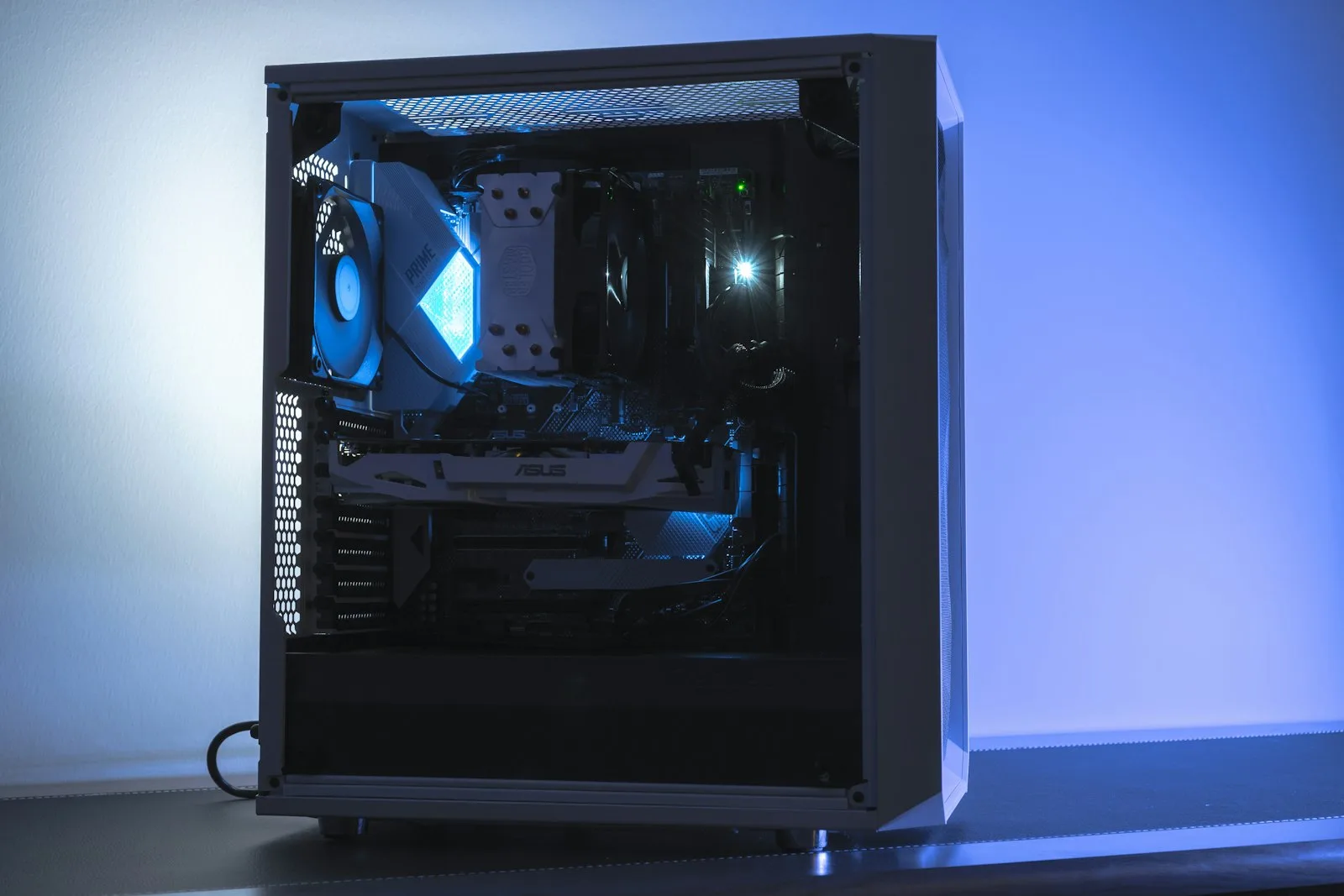
Two cards need genuine PCIe bandwidth and, more often overlooked, physical space between them. Two slots on a specification sheet frequently means two cards pressed against each other, with the upper one starved of air and throttling within minutes.
Check the physical spacing, not the slot count. Workstation boards exist precisely for this and the premium is justified in a way it is not lower down the range.
AI Workstation Thermals Are the Hard Problem
At this tier cooling stops being a detail and becomes the constraint that determines whether the machine performs as specified.
Two flagship cards under sustained inference produce substantial heat in a confined space, and the upper card in a dual configuration always runs hotter. The symptom is not a crash. It is token speed declining steadily over a long job as the card throttles.
Three things that matter. Genuine spacing between cards. Strong directed intake, with more intake than exhaust. And fan curves set for continuous load rather than the bursty profile defaults assume.
Some people at this tier move to open frames or dedicated rooms for exactly this reason. If the machine will run long jobs regularly, that is a reasonable rather than eccentric choice.
What This AI Workstation Runs
70B models at 4-bit on the dual-card path, or at full FP16 precision on the professional card. The precision difference is real for tasks where nuance matters.
120B-plus mixture-of-experts models on the 96GB card, which is capability no consumer configuration reaches.
Genuine fine-tuning rather than the constrained version smaller cards allow.
Multiple large models simultaneously, which matters if you are serving several workloads rather than working interactively.
Long context at scale without the constant trade-off between model size and window that defines cheaper tiers.
AI Workstation Economics, Done Honestly
At this price the build has to justify itself against a hosted API, and the calculation is more interesting than either side usually admits.
Where the AI workstation loses. Cost per token, straightforwardly. Budget-tier hosted inference costs very little per million tokens. Against a five-thousand-dollar machine plus electricity plus your maintenance time, a low-volume user will never reach break-even. Frontier hosted models are also still ahead on the hardest reasoning tasks.
Where it wins. Three things money cannot buy from an API. Unlimited volume, once the hardware exists, throughput costs electricity rather than a metered bill that compounds daily. Provable privacy, a technical property, not a policy promise, which for regulated or client work is frequently the only defensible option. Permanence, nothing gets deprecated, repriced or retired underneath you.
The honest break-even question is not “how many tokens” but “does one of those three describe my situation”. If yes, the AI workstation pays for itself in ways a spreadsheet does not capture. If no, no amount of token arithmetic will make it work.
If Other People Will Use It
A workstation serving a team behaves differently to one serving a person, and the differences catch people out.
Concurrency eats memory. Every simultaneous request needs its own KV cache. A model that fits comfortably for one user can exhaust memory with four, which is why the 96GB path suits multi-user work better than 64GB does.
Uptime becomes a requirement. A machine under your desk that you restart when it misbehaves is fine. One that colleagues depend on is infrastructure, and infrastructure needs monitoring, a named owner and a plan for when it fails.
Queueing matters more than raw speed. Serving frameworks handle batching and queuing far better than running a model directly. If several people will use this, that layer is not optional.
At that point you are running a small internal service rather than a workstation, the concepts in our MLOps guide start applying, and the maintenance burden shifts from occasional to ongoing.
Six AI Workstation Mistakes at This Tier
1. Buying two cards without checking physical spacing. Two slots on paper frequently means two cards touching, with the upper one throttling within minutes.
2. Undersizing the power supply. Two flagships under sustained load is a harder ask than any gaming configuration.
3. Assuming the case is fine. Full tower does not automatically mean dual-GPU airflow. Check clearance and intake specifically.
4. Buying for 70B without confirming you need it. The most expensive mistake available. Three months on a 32GB machine answers it.
5. Ignoring noise. An AI workstation under sustained load is genuinely loud. If it shares a room with you, that matters daily.
6. Comparing against API pricing without counting your time. Maintenance is real and recurring. Include it or the comparison is dishonest.
Who This Is Actually For
Worth being direct, because this is a large amount of money.
Justified if: local inference is business-critical, you handle data that legally cannot leave your infrastructure, you run high enough volume that API costs exceed the hardware within a year, or you are doing research that needs models at full precision.
Not justified if: you want the best available hardware, you might need 70B someday, or you are comparing against API pricing without counting your own maintenance time.
The uncomfortable comparison: for most individuals and many small teams, the 32GB build plus an API subscription for the occasional hard problem delivers more capability per pound than this workstation. That combination covers the common case locally and the rare case cheaply.
Prebuilt AI Workstation Versus Building It Yourself
At cheaper tiers building yourself is straightforwardly better value. At this one the answer is genuinely less clear, and it is worth thinking about properly.
The case for prebuilt. The hard part of a dual-GPU AI workstation is not assembly. It is thermal and power engineering. Vendors who build these regularly have solved airflow between cards, validated the power delivery under sustained load, and will support the machine when something misbehaves. You are paying for engineering you would otherwise do yourself, badly, twice.
The case for building. A meaningful cost saving, complete control over component choice, and the ability to specify for a second card even if you start with one. If you have built machines before and are comfortable solving an airflow problem, the money saved is real.
The middle path most people miss. Buy a workstation-class barebones or chassis designed for dual GPUs, then fit your own cards, memory and storage. You inherit the thermal engineering and avoid the vendor markup on components you can buy yourself.
The deciding question is not budget. It is whether you would enjoy diagnosing a throttling problem at eleven at night, or whether you want a supported machine that works. Both are legitimate answers at this price.
Will This AI Workstation Age Well?
A fair question at this outlay, and the answer is more encouraging than for most computing purchases.
Capacity ages considerably better than compute for inference. A 96GB card will still run models that future consumer hardware cannot touch, because model sizes have grown faster than consumer memory has. The card that looks expensive today is buying a capability ceiling rather than a speed number, and ceilings hold their value.
Two things work against it. Quantisation keeps improving, which means cheaper hardware keeps catching up on the models you bought this machine to run. And architectural efficiency gains mean a smaller future model may match today’s 70B, making the threshold that justified this AI workstation less special.
On balance, a three to four year useful life is realistic for the professional path and slightly less for dual consumer cards, which age faster and are harder to resell as a pair. Neither is a bad outcome for hardware doing genuine work.
Frequently Asked Questions
Two 5090s or one professional card?
Two cards for value and 70B at 4-bit. One professional card for simplicity, lower power, and 70B at full precision. If budget allows the professional route and you value not troubleshooting, take it.
Does inference actually split across two cards well?
Yes. Inference splits considerably better than training does. The complexity is in the build rather than the software.
Do I need ECC memory?
For jobs running days at a time, it is worth it. For interactive use, less so.
Will this be obsolete in two years?
Capacity ages better than compute for this workload. A 96GB card will still run models a future consumer card cannot, because model sizes grow faster than consumer memory does.
Can I start with one card and add the second?
Yes, and only if you specify the power supply, motherboard and case for two from the start. Retrofitting those costs more than the card.
Is a prebuilt workstation worth considering?
At this tier, sometimes. Vendors handle the thermal and power engineering that is genuinely hard with dual cards, and you pay for it. Worth pricing if you would rather not solve airflow yourself.
Verdict
This tier is defined by one threshold, 70B models, and justified only by needing to cross it. The engineering that makes it work is unglamorous: power delivery, PCIe spacing and airflow, none of which appear in benchmark charts.
If you genuinely need 70B locally, the professional card is the lower-stress path and the dual-card build is the better value. Both work.
If you are not certain you need 70B, you almost certainly do not. Build the 32GB machine, use it for three months, and let real work tell you whether the ceiling is a problem. That answer costs a fraction of guessing wrong at this price.
Other builds: the budget local AI build at around $1,000, and prebuilt AI workstations for when buying beats building.