
Table of Contents
- The Short Verdict
- What the DGX Spark Actually Is
- The DGX Spark Price Problem
- 128GB Unified Memory Is the Whole Point
- What a DGX Spark Actually Runs
- Where the Performance Falls Short
- DGX Spark Versus the Alternatives
- Buy a DGX Spark or Rent Cloud GPUs?
- DGX Spark Versus a Normal Workstation
- Who It Is Genuinely For
- The Case for Waiting
- Living With a DGX Spark Day to Day
- 5 Mistakes Buying a Personal AI Machine
- Frequently Asked Questions
- Verdict
Disclosure on method: this is a buying guide assembled from NVIDIA’s specifications and published third-party testing, not a hands-on review. We have not had a DGX Spark on a desk. Where a performance figure appears below it comes from other people’s measurements and is attributed.
The NVIDIA DGX Spark is a small box that runs models most desktops cannot, at a price that makes you think carefully, with a performance profile that is stranger than the marketing suggests.
It launched in October 2025 at $3,999. By February 2026 the price had risen to $4,699, driven by global memory supply constraints. A product getting 17 percent more expensive after launch is unusual enough to mention up front, because it changes the calculation this review keeps coming back to.
The Short Verdict
Buy a DGX Spark if you need to work with 70B models at full precision on your own hardware, your workflow is CUDA-native, and the alternative is not being able to do the work at all.
Do not buy one if you mainly run models under 30B, you care about tokens per second more than model size, or you could rent an H100 for the handful of days a year you actually need this much memory.
What the DGX Spark Actually Is
A desktop machine built around the NVIDIA GB10 Grace Blackwell Superchip: a 20-core Arm CPU, a Blackwell GPU with 1,024 Tensor Cores, and 128GB of unified memory on one package. NVIDIA quotes up to 1 petaFLOP of FP4 AI performance.
Two things in that description do most of the work.
Unified memory. The CPU and GPU share one pool. There is no copying across PCIe and no separate VRAM ceiling. Your model budget is 128GB, full stop.
Arm, not x86. This matters more than spec sheets imply. It is a CUDA machine, so the NVIDIA stack works, but anything expecting x86 needs checking before you rely on it.
The DGX Spark Price Problem
At $3,999 this was an interesting proposition. At $4,699 it is a harder argument, and it is worth being direct about why.
That money buys 128GB of unified memory and a Blackwell GPU in a small, quiet box that draws little power. What it does not buy is raw throughput competitive with a discrete high-end card, or an upgrade path, or resale value in a market that has not established one.
The price rise also tells you something about supply. Memory constraints pushed it up once and could do so again. If you are budgeting for one, budget for the current number rather than the launch number.
128GB Unified Memory Is the Whole Point
Everything interesting about the DGX Spark follows from this one number, so it deserves the space.
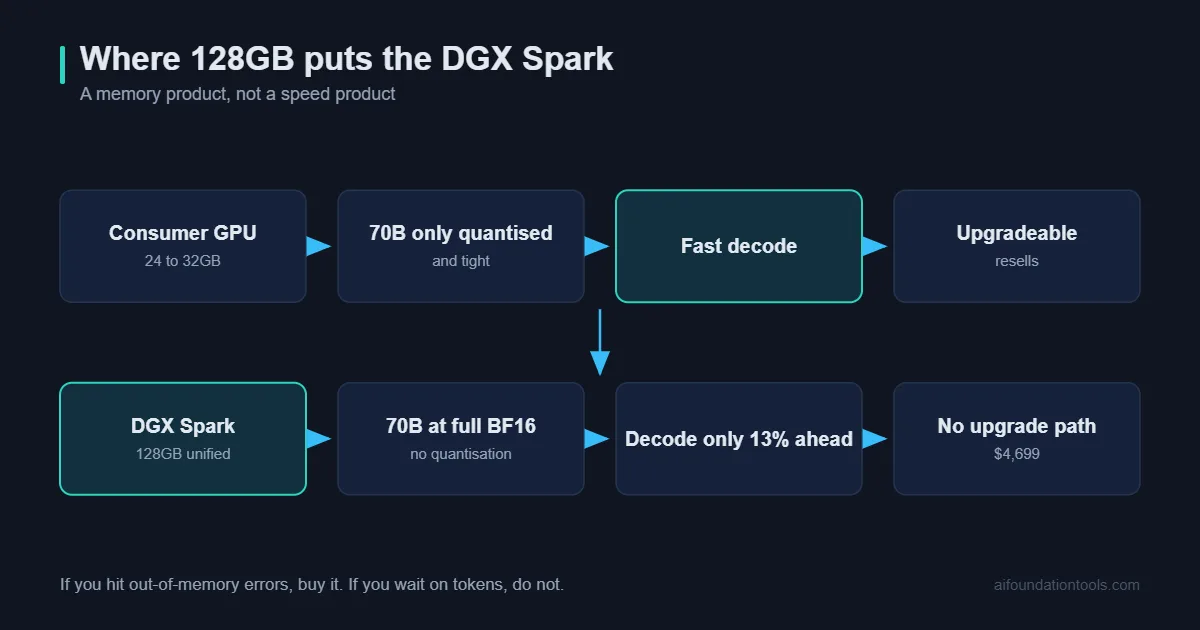
A consumer flagship gives you 24 to 32GB of VRAM. A data centre H100 gives you 80GB. The DGX Spark gives you 128GB shared between CPU and GPU, in a box on your desk, for a fraction of what an H100 system costs.
That inverts the usual constraint. On a normal workstation, the question is which quantisation lets your model fit. Here, models that would not load at all on a 32GB card load at full precision, and the question becomes how fast they run rather than whether they run.
If your work is blocked by model size, this is the cheapest way to unblock it short of renting. If your work is blocked by speed, this does not help you and you should read the next two sections carefully.
What a DGX Spark Actually Runs
With 128GB of unified memory, published testing reports the DGX Spark running Llama 3.3 70B at full BF16 with no quantisation, 405B-class models at Q2 to Q3, and multiple mid-sized models loaded at once, such as two 30B models simultaneously.
That last capability is underrated and worth calling out. Running an agent that uses a large model for reasoning and a small one for classification, both resident, without swapping weights, is genuinely awkward on a 24GB card and straightforward here. For agent development specifically, that changes what you can prototype locally.
Full-precision 70B on a desk is the headline. Being able to keep several models warm at once is the thing you will actually use.
Where the Performance Falls Short
This is the section most coverage skips, and it is the one that should decide your purchase.
Published testing shows the DGX Spark excelling at prefill, reported at around five times faster than comparable competitors, while its decode speed advantage is roughly 13 percent. Those two numbers describe very different experiences.
Prefill is processing the prompt. Decode is generating the response. If you feed it long documents and want a short answer, the DGX Spark looks excellent. If you want it to write at length, the advantage largely disappears and you are paying flagship money for a modest gain.
The same testing notes limited scalability, which constrains its utility for larger workloads. This is a single-box machine. There is no meaningful path to two of them working as one.
The honest summary: the DGX Spark is a memory-capacity product wearing performance marketing. Buy it because 128GB unlocks work you cannot otherwise do. Do not buy it expecting a fast machine, because on the metric most people feel day to day it is not remarkable.
DGX Spark Versus the Alternatives
Competing options at similar money are real, and reviewers have not been kind about this comparison.
| Option | Memory | Rough cost | Where it wins |
|---|---|---|---|
| DGX Spark | 128GB unified | $4,699 | CUDA stack, prefill, model capacity |
| AMD Strix Halo | Up to 128GB unified | Lower | Price, x86 compatibility |
| Apple M4 Pro Mini | Up to 64GB unified | Lower | Price, silence, general use |
| RTX 5090 workstation | 32GB VRAM | ~$4,000 built | Raw speed, upgradeable, resells |
Competitors including AMD’s Strix Halo and Apple’s M4 Pro Mini offer comparable or better performance at lower prices, which challenges the DGX Spark’s position considerably.
What survives that comparison is CUDA. If your work depends on the NVIDIA software stack, on libraries that assume CUDA, or on parity with what you deploy to in production, the alternatives are cheaper machines that do not solve your problem. That is a narrower audience than NVIDIA’s marketing implies, and for that audience it is a real advantage.
Buy a DGX Spark or Rent Cloud GPUs?
The comparison nobody makes properly, so let us do the arithmetic.
$4,699 buys roughly 1,030 hours on an H100 at OVH’s rate of about EUR 2.80 an hour. That is around 43 days of continuous H100 time, and an H100 is a considerably faster machine.
Renting wins on raw value unless three things are true: you use it most days, your data cannot leave your premises, or the metered clock changes how you work. That third one is real and underrated. People experiment differently when the meter is not running, and for research that difference has value that does not appear in a spreadsheet.
If you are considering this, price the alternative honestly first. Our OVH GPU server review and RunPod review cover the rental side, and for occasional heavy jobs renting usually wins.
DGX Spark Versus a Normal Workstation
For similar money you could build a workstation around a current flagship consumer card. That machine would be faster at generation, upgradeable, repairable, resellable, and useful for things that are not AI.
It would also cap you at around 32GB of VRAM, which means 70B models only at aggressive quantisation and no chance of full-precision work at that size.
So the decision reduces to one question. Is your constraint memory or speed? If you keep hitting out-of-memory errors, the DGX Spark solves your actual problem. If you keep waiting for tokens, a workstation solves it better and cheaper. Our AI workstation build guide covers that path in detail.
Who It Is Genuinely For
A good fit: Researchers working with large models who need local iteration. Teams prototyping multi-model agent systems. Developers who deploy to NVIDIA data centre hardware and want a matching local environment. Anyone whose data legally cannot go to a cloud provider.
A poor fit: Hobbyists running 7B to 13B models, who are far better served by a consumer card. Anyone whose priority is generation speed. Teams who need to scale beyond one machine. Buyers who value upgradeability or resale.
The Case for Waiting
NVIDIA is reported to be planning an RTX Spark for late 2026, positioned as more affordable and more versatile.
If that arrives as described, buying a DGX Spark now at a price that has already risen once looks like poor timing unless you need it this quarter. Against that, roadmaps slip and the current machine is available today.
The reasonable position: if the work is blocked right now and the memory unblocks it, buy. If it is a want rather than a blocker, waiting to see what the successor looks like costs you nothing.
| If you | Do this | Why | |
|---|---|---|---|
| Need 70B at full precision locally | DGX Spark | Nothing else at this price has 128GB | Check price |
| Run 7B to 30B models | Consumer GPU build | Faster and much cheaper | See GPU guide |
| Need big models occasionally | Rent by the hour | 1,030 H100 hours for the same money | Check price |
| Want it but are not blocked | Wait for RTX Spark | Reported for late 2026, cheaper | – |
Living With a DGX Spark Day to Day
Specifications describe a machine. They do not describe using one, and a few practical points come up repeatedly in owner reports.
The Arm question resolves mostly in your favour, with exceptions. PyTorch, CUDA, Ollama and the mainstream inference stacks work. What tends to break is the periphery: an obscure Python wheel with no Arm build, a Docker image that assumes x86, a vendor tool that ships an x86 binary. None of this is fatal, and all of it costs an afternoon the first time you hit it.
Unified memory changes how you think about loading. There is no host-to-device copy to optimise, which removes a whole category of tuning. It also means system processes and your model draw from the same pool. Running a browser with forty tabs while serving a 70B model is not free in the way it would be with discrete VRAM.
It is genuinely quiet and cool. Compared with a workstation running a 575W card under sustained load, the difference in noise, heat and electricity is not a rounding error. If the machine shares a room with you, this counts for more than a spec sheet suggests.
Model loading from disk is the slow step. With this much memory you will keep several models resident, which means the initial load matters and subsequent switching does not. Plan storage accordingly, because a fast NVMe drive is doing real work here.
None of these are reasons to buy or not buy a DGX Spark. They are the things people mention after three months, which is a different and more useful list than the one on the box.
5 Mistakes Buying a Personal AI Machine
1. Buying capacity you will not use. If your models are under 30B, 128GB is money spent on headroom you never reach.
2. Reading petaFLOPs as speed. The 1 petaFLOP figure is FP4, a specific and narrow measure. Decode performance is what you feel, and it is unremarkable here.
3. Not checking Arm compatibility. The CUDA stack is fine. Your other tooling might not be. Check before you buy, not after.
4. Ignoring the rental comparison. Roughly 43 days of continuous H100 time for the same money, on faster hardware. That deserves a serious answer before you spend.
5. Assuming it will hold value. No established resale market, no upgrade path. Treat the full $4,699 as consumed.
Frequently Asked Questions About the DGX Spark
How much does the DGX Spark cost? $4,699 as of early 2026, up from $3,999 at its October 2025 launch, attributed to memory supply constraints.
Can it train models? Fine-tuning yes, within its memory. Training from scratch is not what this is for.
Does Ollama work on it? Yes. Anything in the CUDA ecosystem with Arm support runs, and the large memory pool is a genuine advantage for serving multiple models.
Is it faster than an RTX 5090? Not at generation. It holds four times the memory. Different tools for different constraints.
Can I connect two together? Scalability is limited. Treat it as a single-box machine.
Is it quiet? Yes, and the low power draw is a real benefit next to a workstation with a 575W card in it.
Verdict
The DGX Spark is a memory product. 128GB of unified memory in a quiet desktop box is the entire reason to buy one, and for the people it is aimed at, that capability is worth the money because nothing else at this price offers it.
Everything else argues against it. The price rose 17 percent after launch. Decode performance is 13 percent better than rivals rather than transformative. Cheaper machines from AMD and Apple match or beat it on general performance. A successor is reported for late 2026. And $4,699 buys roughly 1,030 hours on faster rented hardware.
Buy it if a 128GB memory pool unblocks work you cannot do otherwise and the data has to stay with you. Otherwise rent an H100 when you need one, build a consumer workstation for daily work, and keep the difference.
Sources and Further Reading
Specifications, pricing and performance figures above come from NVIDIA and from published third-party testing in 2026, not from our own measurement.
- NVIDIA DGX Spark product page
- NVIDIA DGX Spark documentation
- TechPowerUp, for independent hardware data
- Ollama model library, for the model sizes referenced
- Hugging Face inference docs, on precision and memory
Related on this site: how much VRAM you actually need, the AI workstation build guide, and running a local AI agent.